Tourmaline

Black Tourmaline (Schorl)

Schorl, the iron-rich end of the tourmaline family, grows in deeply striated black prisms with a distinctive rounded-triangular cross-section.
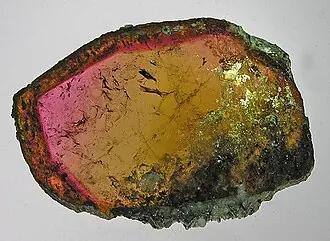
Black Tourmaline (Schorl) — mineral specimen
Reference photograph: Robert M. Lavinsky, CC BY-SA 3.0 · source. Specimens in the shop vary.

Judging quality

Good specimens show glassy, unbroken prism faces, clear vertical striations and an intact termination. Broken shards and heavily coated crystals are commonplace.

Care

Hard and durable but brittle along the length. Rinse and dry.

History & lore

Dutch traders in the eighteenth century used heated tourmaline to pull ash out of meerschaum pipes, calling it aschentrekker.

Cultural history, recorded as tradition rather than as medical or scientific claim.

Common questions about Black Tourmaline (Schorl)

What is Black Tourmaline (Schorl)?
Schorl, the iron-rich end of the tourmaline family, grows in deeply striated black prisms with a distinctive rounded-triangular cross-section.
How hard is Black Tourmaline (Schorl) and what is it made of?
Black Tourmaline (Schorl) is a Tourmaline-family mineral with the composition NaFe3Al6(BO3)3Si6O18(OH)4. It crystallizes in the trigonal system and rates 7-7.5 on the Mohs hardness scale. It occurs in black.
Where does Black Tourmaline (Schorl) come from?
Notable localities for Black Tourmaline (Schorl) include Brazil, Pakistan, Namibia, Madagascar.
How do you tell good Black Tourmaline (Schorl) from filler?
Good specimens show glassy, unbroken prism faces, clear vertical striations and an intact termination. Broken shards and heavily coated crystals are commonplace.
How do you care for Black Tourmaline (Schorl)?
Hard and durable but brittle along the length. Rinse and dry.

See it in person

Photographs only go so far

Both rooms are open six days a week, and there is always someone happy to pull pieces out of the case so you can compare them under the light.

Plan a visit
Share Black Tourmaline (Schorl)