Judging quality
Blue flash from irregular feldspar grains scattered through a dark grey groundmass, rather than the sheet flash of labradorite. Sold as 'black moonstone' at times.
Igneous
Norwegian building stone shot with silvery-blue schiller from feldspar exsolution lamellae — labradorescence in a dark grey rock. Widely used as facade cladding, and quietly one of the most beautiful stones in any city.
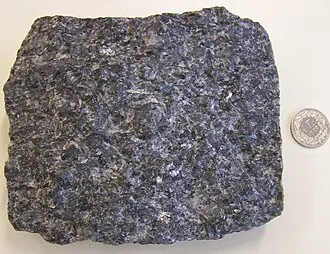
Blue flash from irregular feldspar grains scattered through a dark grey groundmass, rather than the sheet flash of labradorite. Sold as 'black moonstone' at times.
Durable. Water and cloth.
Norway's national stone, quarried around Larvik and shipped worldwide; it clads bank buildings from Oslo to New York.
Cultural history, recorded as tradition rather than as medical or scientific claim.
See it in person
Both rooms are open six days a week, and there is always someone happy to pull pieces out of the case so you can compare them under the light.