The crystal encyclopedia
44 of 218
Speaking clearly and truthfully — the color of the throat band.
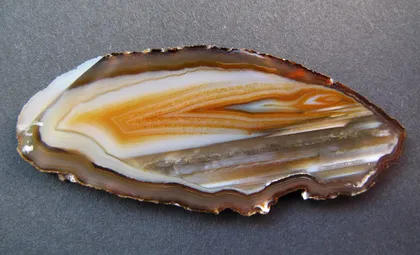
Chalcedony
Agate
Banded chalcedony, formed as silica-rich fluid seeped in layers into volcanic cavities. Every agate is a cross-section of its own slow filling, which is why no two slices repeat.
Mohs 6.5-7 · Banded, Grey
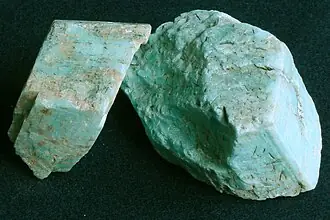
Feldspar
Amazonite
Blue-green microcline feldspar, colored by trace lead. Colorado crystals grown alongside smoky quartz are among the most striking mineral specimens produced in North America.
Mohs 6-6.5 · Turquoise, Green
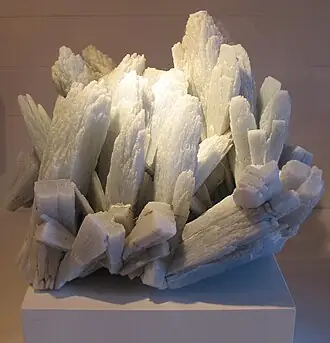
Sulfate
Angelite (Anhydrite)
Blue anhydrite — gypsum without its water. Left damp long enough it will slowly reabsorb water and revert toward gypsum.
Mohs 3.5 · Pale blue, Grey
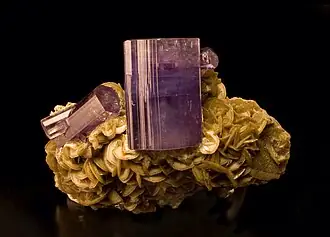
Phosphate
Apatite
The mineral of bone and tooth enamel, and a gem in its own right. Neon blue-green Madagascan apatite is one of the most electric colors in the mineral kingdom.
Mohs 5 · Blue, Green
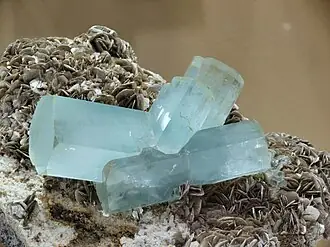
Beryl
Aquamarine
Blue beryl, colored by iron, and the same mineral species as emerald and morganite. Crystals grow as long hexagonal prisms with flat terminations and can reach enormous size.
Mohs 7.5-8 · Blue, Blue-green
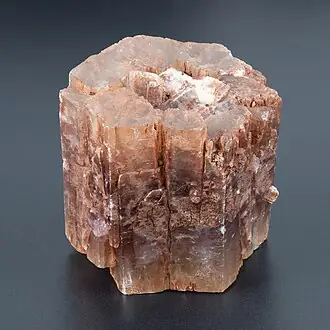
Carbonate
Aragonite
Chemically identical to calcite but with a different crystal structure, aragonite grows in radiating sputnik clusters, coral-like sprays and the nacre of shells.
Mohs 3.5-4 · Brown, Orange
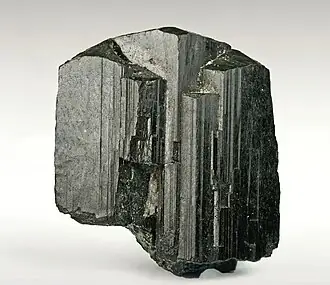
Amphibole
Arfvedsonite
A dark sodium amphibole that carries a startling blue-to-gold flash along its cleavage — sold widely and inaccurately as 'nuummite', which it superficially resembles.
Mohs 5-6 · Black, Iridescent
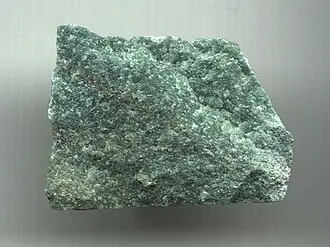
Quartz
Aventurine
Quartzite spangled with reflective mica platelets — green from fuchsite, blue from dumortierite. The shimmer is called aventurescence.
Mohs 6.5-7 · Green, Blue
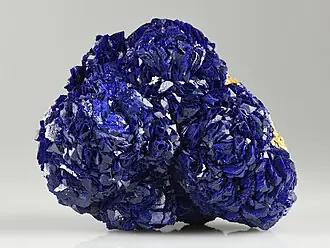
Carbonate
Azurite
Intense blue copper carbonate, frequently intergrown with green malachite into which it slowly alters over geological time.
Mohs 3.5-4 · Deep blue
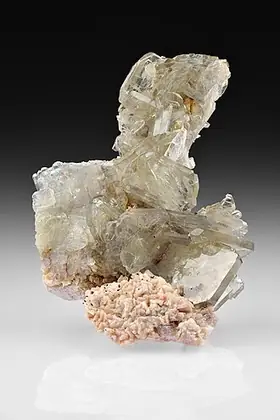
Sulfate
Barite
Unusually heavy for a pale mineral — its high barium content makes barite feel like metal in the hand. Grows in blades, roses and elegant tabular crystals.
Mohs 3-3.5 · White, Blue
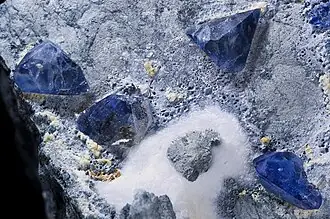
Silicate
Benitoite
California's state gemstone and a genuine local rarity: sapphire-blue triangular crystals in white natrolite, from one small serpentinite body in San Benito County. The mine is effectively worked out, which makes every good specimen finite.
Mohs 6-6.5 · Blue, Deep blue
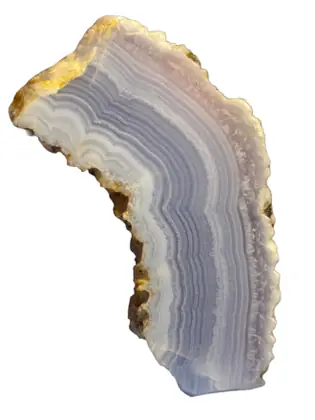
Chalcedony
Blue Lace Agate
Powder-blue banded chalcedony threaded with white lace, from a single small Namibian deposit that has been effectively mined out — which is why good material now costs multiples of what it did a decade ago.
Mohs 6.5-7 · Pale blue, Sky blue
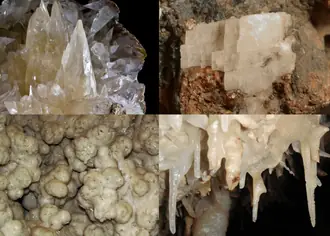
Carbonate
Calcite
One of the most polymorphic minerals known, with hundreds of crystal habits and every color of the spectrum. Optical calcite from Iceland splits an image in two through double refraction.
Mohs 3 · Orange, Honey
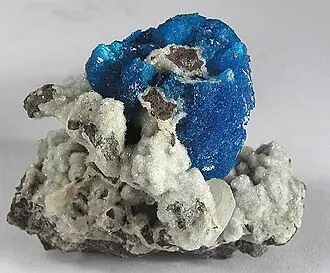
Silicate
Cavansite
Vivid blue rosettes of calcium vanadium silicate that grow in the basalt quarries near Pune, almost always perched on white stilbite or heulandite.
Mohs 3-4 · Electric blue
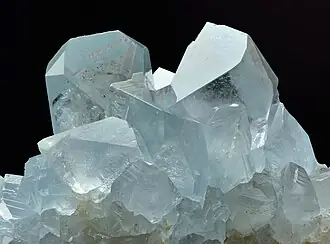
Sulfate
Celestite
Strontium sulfate that lines geodes with pale sky-blue tabular crystals. Madagascan geodes are the most familiar form worldwide.
Mohs 3-3.5 · Pale blue, White
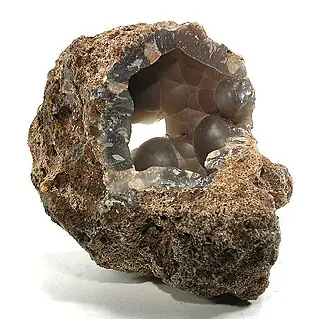
Chalcedony
Chalcedony
Microcrystalline quartz without banding — the parent material of agate, carnelian and jasper. The Turkish and Namibian blue-grey material has a milky glow like frozen smoke.
Mohs 6.5-7 · Blue, White
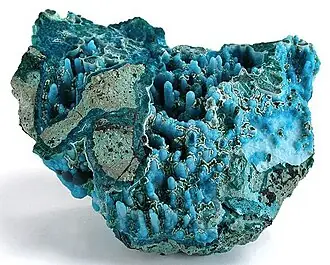
Silicate
Chrysocolla
A soft, hydrated copper silicate in vivid blue-green. On its own it is too fragile to work, so gem material is usually chrysocolla in chalcedony, called gem silica.
Mohs 2-4 · Blue-green, Cyan
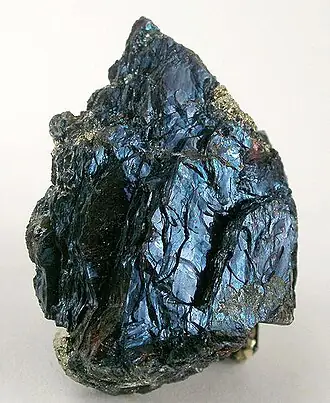
Sulfide
Covellite
Indigo copper sulfide with a peacock iridescence of purple, blue and bronze across its metallic plates. Butte, Montana produced crystallised specimens that have never been matched.
Mohs 1.5-2 · Deep blue, Iridescent
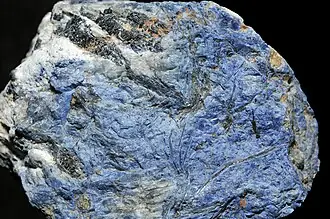
Silicate
Dumortierite
Dense blue borosilicate, usually massive or as fibrous inclusions in quartz. Hard, deeply colored and often mistaken for sodalite or lapis.
Mohs 7-8.5 · Blue, Violet
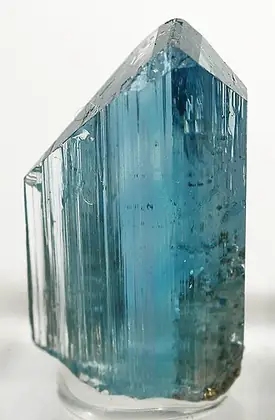
Silicate
Euclase
A collector's gem in soft aquamarine blue, notoriously difficult to cut because of perfect cleavage — the name means 'easily broken'. Colombian crystals from the emerald belt are the finest blue known.
Mohs 7.5 · Pale blue, Blue
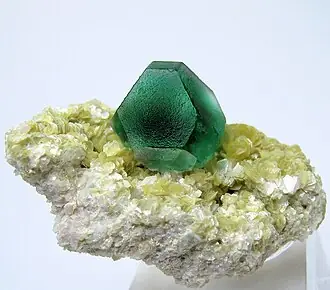
Halide
Fluorite
The most colorful mineral in the world, fluorite grows in perfect cubes and octahedra, often color-zoned in bands of green, purple and clear within a single crystal.
Mohs 4 · Green, Purple
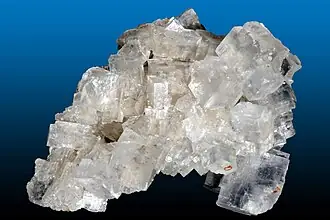
Halide
Halite
Rock salt, crystallising in perfect cubes — sometimes hopper-shaped with stepped hollow faces. Rare blue halite from German potash mines gets its color from lattice defects, not impurities.
Mohs 2-2.5 · Colorless, Pink
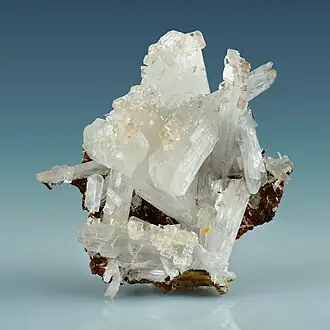
Silicate
Hemimorphite
Zinc silicate that forms both bladed crystal sprays and soft blue botryoidal crusts. The Chinese blue material is among the most beautiful secondary zinc minerals.
Mohs 4.5-5 · Blue, Colorless
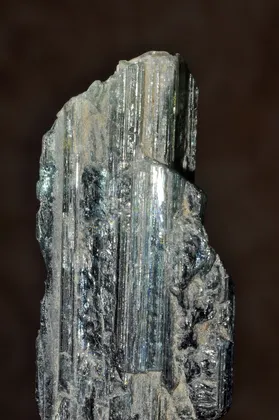
Tourmaline
Indicolite Tourmaline
Blue elbaite, the scarcest common-market tourmaline color. Runs from a teal-leaning steel blue to a deep ink, often shading into green along the crystal.
Mohs 7-7.5 · Blue, Deep blue
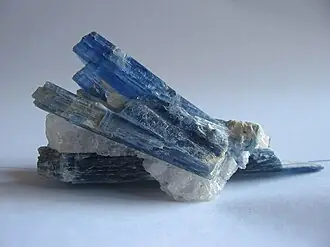
Silicate
Kyanite
A remarkable mineral with two different hardnesses in one crystal: about 4.5 along the blade and 7 across it. Blue blades from Brazil and Nepal are the classic specimen.
Mohs 4.5-7 · Blue, Black
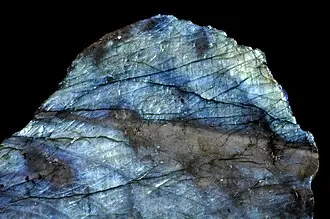
Feldspar
Labradorite
A plagioclase feldspar that hides fire inside dull grey stone. Light striking internal lamellae scatters into blue, gold, green and, in the best pieces, full-spectrum flash.
Mohs 6-6.5 · Grey, Blue
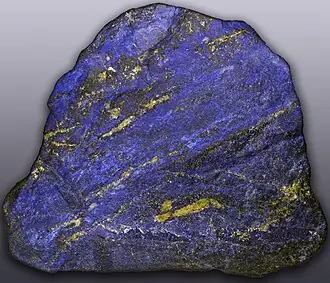
Rock (lazurite)
Lapis Lazuli
A rock rather than a single mineral: deep blue lazurite with white calcite and flecks of golden pyrite. The Sar-e-Sang mines of Badakhshan have supplied the world for over six thousand years.
Mohs 5-5.5 · Blue, Gold
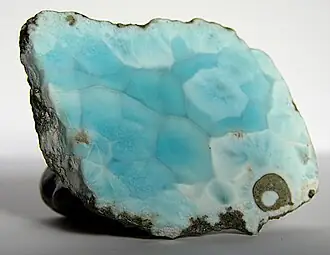
Pectolite
Larimar
Blue pectolite found in exactly one place on earth: a single mountainside in the Dominican Republic. Volcanic in origin, its patterning looks like sunlight on shallow Caribbean water.
Mohs 4.5-5 · Sky blue, White
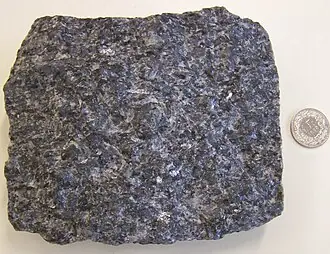
Igneous
Larvikite
Norwegian building stone shot with silvery-blue schiller from feldspar exsolution lamellae — labradorescence in a dark grey rock. Widely used as facade cladding, and quietly one of the most beautiful stones in any city.
Mohs 6-6.5 · Grey, Steel grey
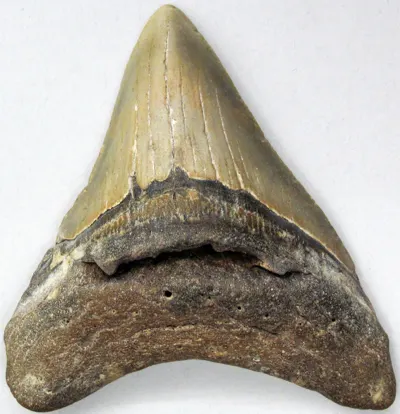
Fossil
Megalodon Tooth
The tooth of Otodus megalodon, the largest shark that ever lived, extinct around 3.6 million years ago. Teeth run from palm-sized to over seven inches; every extra half inch above five is a substantial jump in rarity and price.
Mohs 4.5-5 · Black, Grey
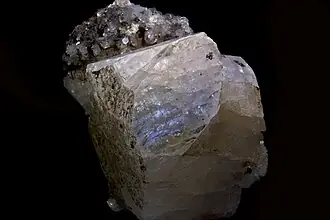
Feldspar
Moonstone
Orthoclase feldspar with a floating blue-white sheen called adularescence, caused by light scattering between microscopic layers of two feldspars.
Mohs 6-6.5 · White, Peach
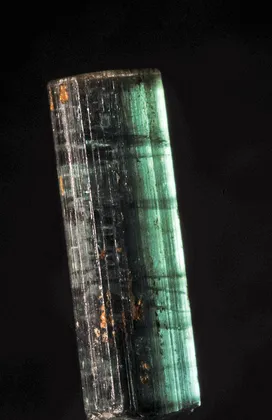
Tourmaline
Paraíba Tourmaline
Copper-bearing tourmaline with a neon blue-green glow unlike any other gem. Brazilian material from the original 1980s Paraíba workings commands a substantial premium over the chemically identical African stones.
Mohs 7-7.5 · Cyan, Turquoise
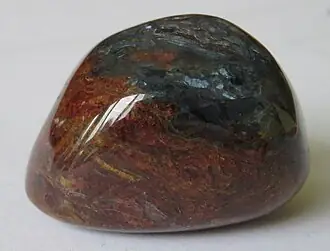
Quartz
Pietersite
A brecciated chatoyant quartz in which fragments of tiger's eye and hawk's eye were shattered and recemented, producing swirling storm-like chatoyancy.
Mohs 6.5-7 · Blue, Gold
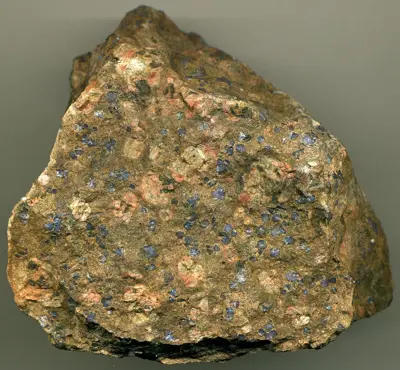
Igneous
Que Sera (Llanite)
A Brazilian rhyolitic rock in soft mottled grey, blue and rose, sold under the trade names que sera and vulcanite. Cuts into calm, cloud-like slabs and spheres.
Mohs 6-7 · Grey, Blue
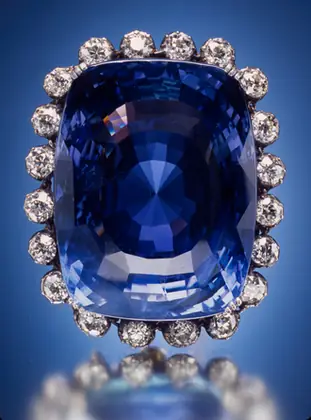
Corundum
Sapphire
Every color of gem corundum other than red. Blue comes from iron and titanium; the pink-orange padparadscha is the rarest and most coveted.
Mohs 9 · Blue, Yellow
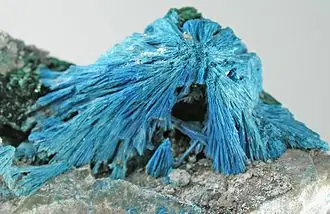
Silicate
Shattuckite
A deep denim-blue copper silicate, usually in fibrous botryoidal crusts and often intergrown with green malachite, blue-green chrysocolla and red cuprite in extraordinary Namibian combination pieces.
Mohs 3.5-4 · Deep blue, Blue
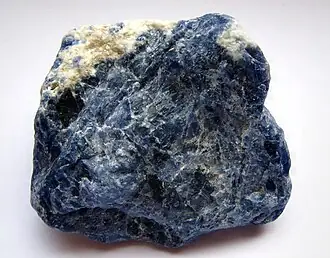
Feldspathoid
Sodalite
Royal blue feldspathoid streaked with white calcite veining. Often confused with lapis, but sodalite lacks pyrite and reads more violet.
Mohs 5.5-6 · Blue, White
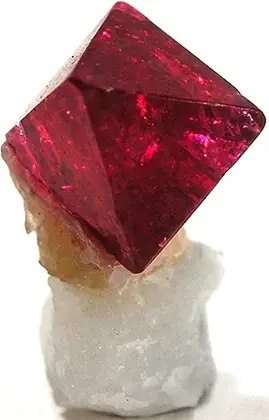
Oxide
Spinel
Long mistaken for ruby, spinel is a distinct mineral with brilliant color, excellent hardness and, crucially, almost no treatment in the trade.
Mohs 7.5-8 · Red, Pink
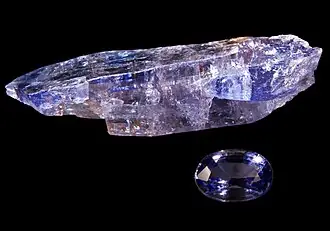
Zoisite
Tanzanite
Blue-violet zoisite found in a single four-square-mile stretch of northern Tanzania. Almost all material is heat-treated to convert brownish rough into blue.
Mohs 6-7 · Violet, Blue
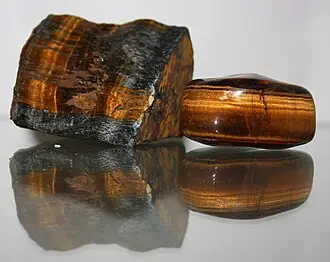
Quartz
Tiger's Eye
Quartz that replaced fibrous crocidolite, inheriting its parallel structure and producing a rolling band of light called chatoyancy. Blue hawk's eye is the unoxidised form.
Mohs 6.5-7 · Gold, Brown
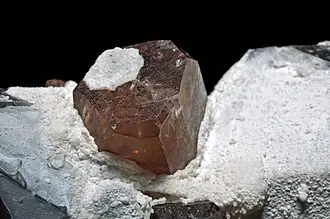
Silicate
Topaz
A very hard silicate that grows in glassy prismatic crystals. Imperial topaz, the sherry-orange to pink material from Ouro Preto, is the aristocrat of the family.
Mohs 8 · Colorless, Blue
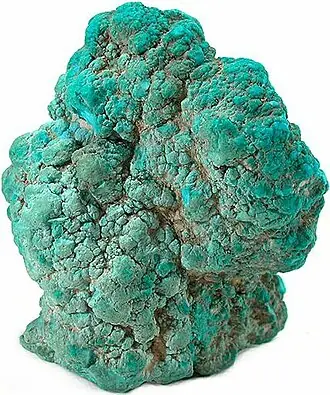
Phosphate
Turquoise
Hydrated copper aluminium phosphate, prized for six thousand years across Persia, Egypt and the American Southwest. Color ranges from Persian sky blue to Sonoran green, often webbed with matrix.
Mohs 5-6 · Blue, Green
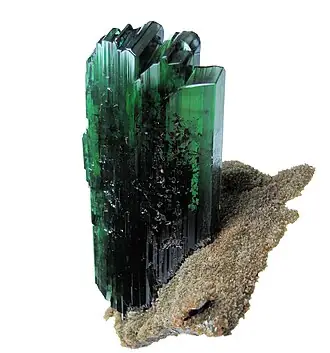
Phosphate
Vivianite
Bladed iron phosphate that grows colorless and darkens through blue-green to near-black as it oxidises in light. Bolivian crystals reach hand size and are among the most dramatic bladed specimens available.
Mohs 1.5-2 · Blue-green, Deep blue
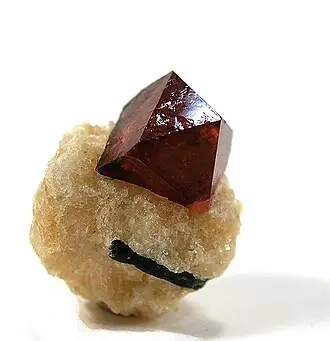
Silicate
Zircon
A genuinely brilliant natural gem with dispersion approaching diamond, and quite unrelated to cubic zirconia despite the name confusion. Cambodian material is heat-treated to the familiar electric blue; natural stones run honey, red and brown.
Mohs 6-7.5 · Blue, Golden
Please noteTraditional properties, effects, and aura associations are shared for cultural, historical, and personal-interest reasons only. They are folklore, not medicine. Nothing here is medical, psychological, or financial advice, and no stone is intended to diagnose, treat, cure, or prevent any condition. Please see a qualified professional for health concerns.