Judging quality
Fine geodes are fully lined, with undamaged transparent blue crystals and no crushed edges from extraction. Color naturally fades in strong light, so bright pieces should be shaded.
Sulfate
Strontium sulfate that lines geodes with pale sky-blue tabular crystals. Madagascan geodes are the most familiar form worldwide.
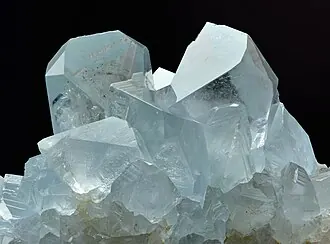
Fine geodes are fully lined, with undamaged transparent blue crystals and no crushed edges from extraction. Color naturally fades in strong light, so bright pieces should be shaded.
Very soft and light-sensitive. Never wash; dust with a dry brush and keep out of the sun.
Celestite burns crimson in a flame test — strontium is the source of red in fireworks.
Cultural history, recorded as tradition rather than as medical or scientific claim.
See it in person
Both rooms are open six days a week, and there is always someone happy to pull pieces out of the case so you can compare them under the light.