The crystal encyclopedia
58 of 218
The quiet end of the collection: amethyst, lepidolite and other stones kept bedside.
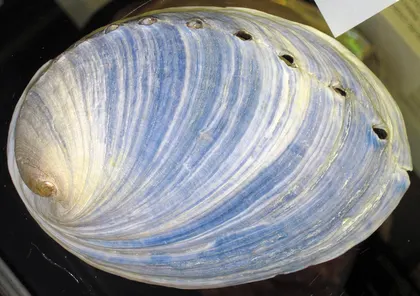
Organic
Abalone Shell
The nacreous inner shell of the abalone sea snail, layered aragonite platelets that scatter light into peacock blues and greens. New Zealand paua is the most saturated; California red abalone runs pink and silver.
Mohs 3.5-4 · Iridescent, Blue-green
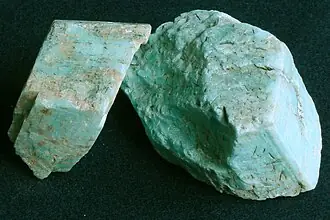
Feldspar
Amazonite
Blue-green microcline feldspar, colored by trace lead. Colorado crystals grown alongside smoky quartz are among the most striking mineral specimens produced in North America.
Mohs 6-6.5 · Turquoise, Green
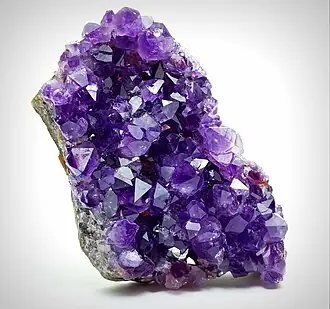
Quartz
Amethyst
Purple quartz, colored by trace iron and natural irradiation. Amethyst forms the great cathedral geodes of Brazil and Uruguay, the deep royal 'Zambian' crystals of Africa, and the delicate pale wands of Vera Cruz. The largest pieces in our collection are geodes taller than a person.
Mohs 7 · Purple, Violet
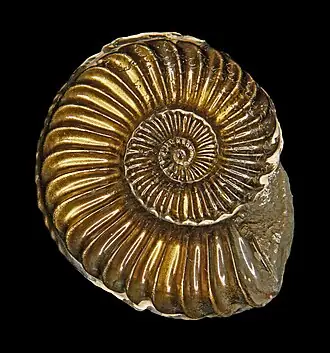
Fossil
Ammonite
The coiled shells of cephalopods that vanished with the dinosaurs. Ammolite, the iridescent Albertan variety, is one of only a handful of organic gemstones.
Mohs 3.5-4 · Brown, Iridescent
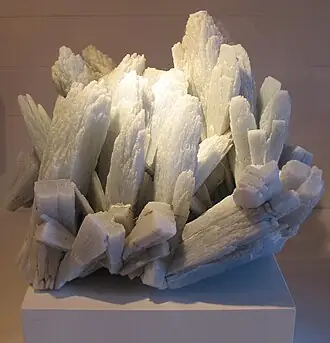
Sulfate
Angelite (Anhydrite)
Blue anhydrite — gypsum without its water. Left damp long enough it will slowly reabsorb water and revert toward gypsum.
Mohs 3.5 · Pale blue, Grey
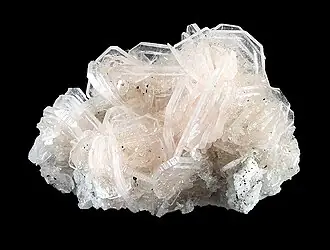
Phyllosilicate
Apophyllite
Glassy pyramidal crystals that grow in the basalt cavities of the Deccan Traps, frequently perched on green stilbite or purple chalcedony.
Mohs 4.5-5 · Colorless, Green
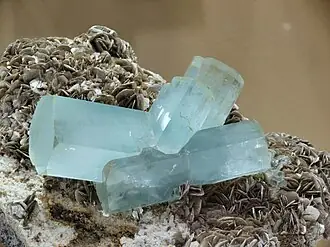
Beryl
Aquamarine
Blue beryl, colored by iron, and the same mineral species as emerald and morganite. Crystals grow as long hexagonal prisms with flat terminations and can reach enormous size.
Mohs 7.5-8 · Blue, Blue-green
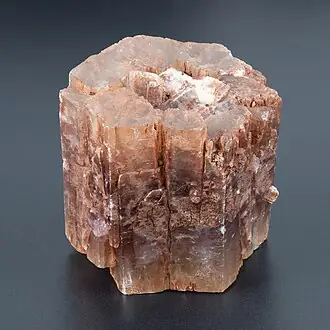
Carbonate
Aragonite
Chemically identical to calcite but with a different crystal structure, aragonite grows in radiating sputnik clusters, coral-like sprays and the nacre of shells.
Mohs 3.5-4 · Brown, Orange
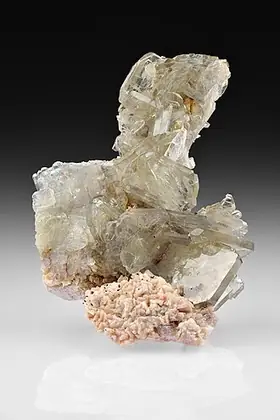
Sulfate
Barite
Unusually heavy for a pale mineral — its high barium content makes barite feel like metal in the hand. Grows in blades, roses and elegant tabular crystals.
Mohs 3-3.5 · White, Blue
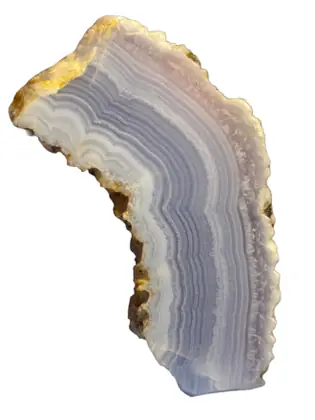
Chalcedony
Blue Lace Agate
Powder-blue banded chalcedony threaded with white lace, from a single small Namibian deposit that has been effectively mined out — which is why good material now costs multiples of what it did a decade ago.
Mohs 6.5-7 · Pale blue, Sky blue
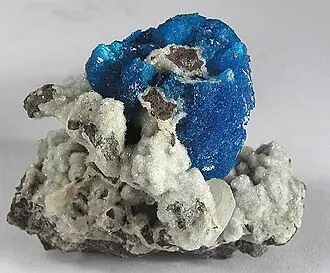
Silicate
Cavansite
Vivid blue rosettes of calcium vanadium silicate that grow in the basalt quarries near Pune, almost always perched on white stilbite or heulandite.
Mohs 3-4 · Electric blue
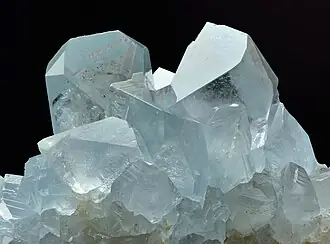
Sulfate
Celestite
Strontium sulfate that lines geodes with pale sky-blue tabular crystals. Madagascan geodes are the most familiar form worldwide.
Mohs 3-3.5 · Pale blue, White
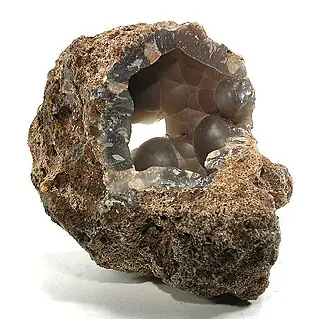
Chalcedony
Chalcedony
Microcrystalline quartz without banding — the parent material of agate, carnelian and jasper. The Turkish and Namibian blue-grey material has a milky glow like frozen smoke.
Mohs 6.5-7 · Blue, White
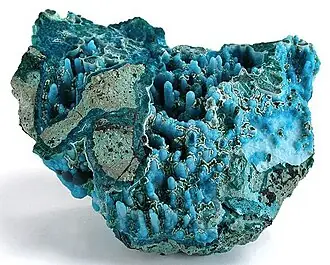
Silicate
Chrysocolla
A soft, hydrated copper silicate in vivid blue-green. On its own it is too fragile to work, so gem material is usually chrysocolla in chalcedony, called gem silica.
Mohs 2-4 · Blue-green, Cyan
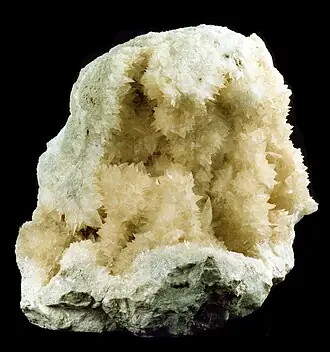
Borate
Colemanite
Glassy colorless borate crystals that grow in blocky, brilliantly lustrous groups. Californian material from the Death Valley borate districts set the standard.
Mohs 4-4.5 · Colorless, White
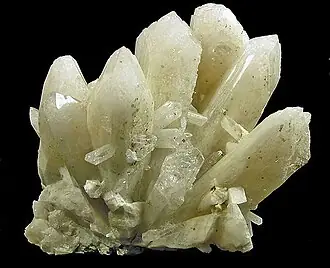
Silicate
Danburite
Chisel-tipped prisms of glassy calcium boron silicate, most familiar from the Charcas mines of San Luis Potosí where crystals grow water-clear and doubly terminated.
Mohs 7-7.5 · Colorless, Pale yellow
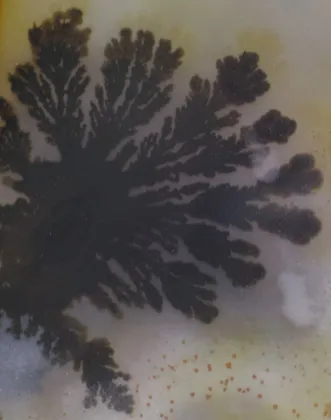
Chalcedony
Dendritic Agate
Translucent chalcedony containing black fern-like dendrites of manganese oxide that look exactly like plants but are pure mineral growth along fractures.
Mohs 6.5-7 · White, Colorless
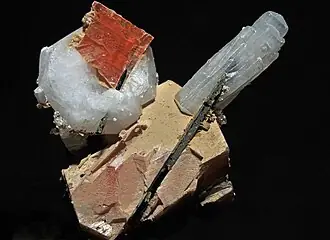
Mineraloid
Dendritic Opal
Common opal without play-of-color, patterned instead by black manganese dendrites branching through pale cream host — sometimes called Merlinite in the trade.
Mohs 5.5-6.5 · Cream, Black
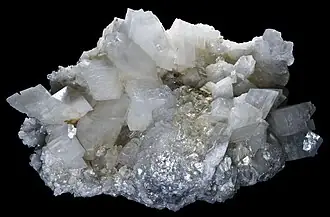
Carbonate
Dolomite
A calcium magnesium carbonate that grows in saddle-shaped curved rhombs, often forming the sparkling white matrix beneath more colorful minerals.
Mohs 3.5-4 · White, Pink
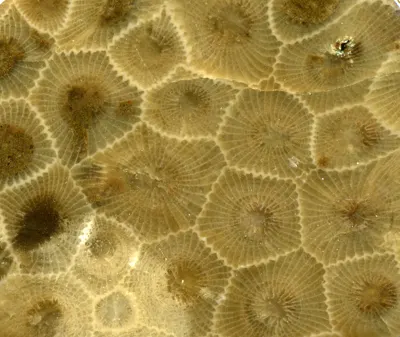
Fossil
Fossil Coral
Colonial coral replaced by agate or chalcedony, preserving the flower-like corallite pattern as a permanent stone. Florida agatised coral shows crisp white florets in grey; Petoskey stone from Michigan is a Devonian rugose coral polished to a honeycomb.
Mohs 6.5-7 · Tan, Grey
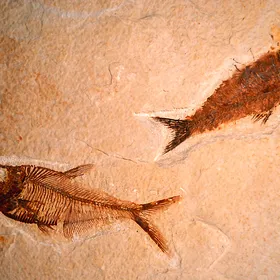
Fossil
Fossil Fish
Eocene lake fish from the Green River Formation — Knightia, Diplomystus, Phareodus — preserved whole with fins and scales in fine laminated limestone. Lebanese Cretaceous material is marine and older.
Mohs 3-4 · Brown, Cream
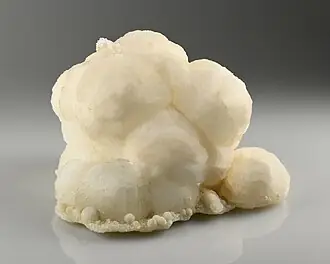
Zeolite-associated
Gyrolite
Pale spherical aggregates with a concentric internal structure, usually nested among green apophyllite and white stilbite in Indian basalt cavities.
Mohs 3-4 · White, Cream
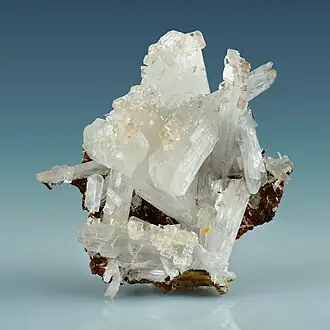
Silicate
Hemimorphite
Zinc silicate that forms both bladed crystal sprays and soft blue botryoidal crusts. The Chinese blue material is among the most beautiful secondary zinc minerals.
Mohs 4.5-5 · Blue, Colorless
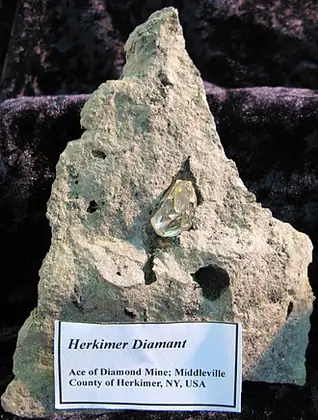
Quartz
Herkimer Diamond
Doubly terminated quartz crystals that grew free-floating in pockets of Cambrian dolostone, emerging with natural points at both ends and extraordinary clarity.
Mohs 7 · Colorless
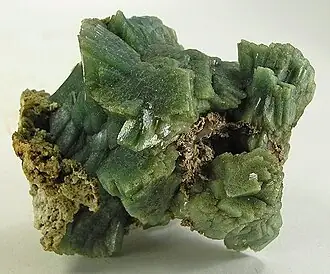
Zeolite
Heulandite
Tabular zeolite crystals in coffin-shaped plates, often orange-peach and frequently mistaken for stilbite, with which it shares its Indian localities.
Mohs 3-3.5 · Peach, White
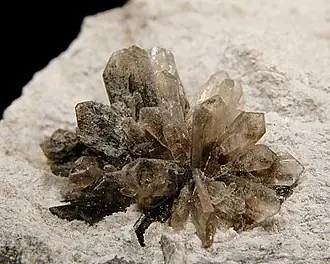
Borate
Howlite
Chalky white borate with grey webbing, porous enough to take dye perfectly — which is why most fake turquoise on the market is dyed howlite.
Mohs 3.5 · White, Grey
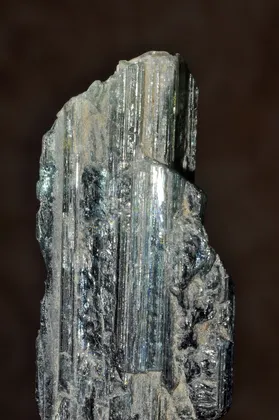
Tourmaline
Indicolite Tourmaline
Blue elbaite, the scarcest common-market tourmaline color. Runs from a teal-leaning steel blue to a deep ink, often shading into green along the crystal.
Mohs 7-7.5 · Blue, Deep blue
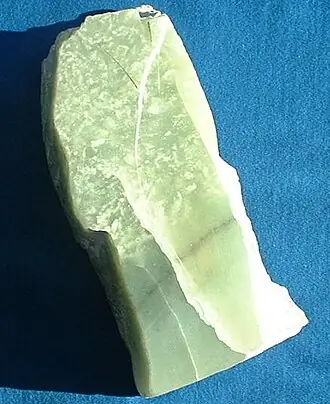
Amphibole
Jade (Nephrite)
One of two minerals sold as jade. Nephrite is an interlocking amphibole felt, which makes it the toughest natural stone known — far harder to break than to scratch.
Mohs 6-6.5 · Green, Cream
Pyroxene
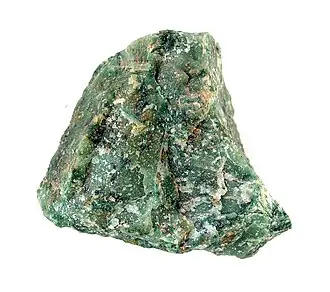
Jadeite
The rarer, harder jade, and the source of imperial green. Nearly all top gem jadeite comes from a small region of northern Myanmar.
Mohs 6.5-7 · Green, Lavender
Sedimentary
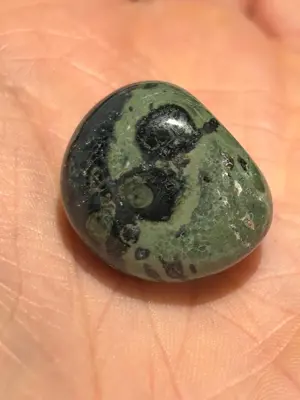
Kambaba Jasper
Dark green and black orbicular stone built from fossilised cyanobacterial colonies — technically a stromatolite rather than a jasper. The swirling eyes give it an unmistakable reptilian look.
Mohs 6-7 · Bottle green, Black
Pectolite
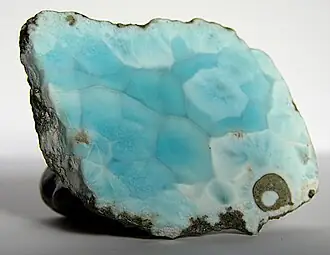
Larimar
Blue pectolite found in exactly one place on earth: a single mountainside in the Dominican Republic. Volcanic in origin, its patterning looks like sunlight on shallow Caribbean water.
Mohs 4.5-5 · Sky blue, White
Mica
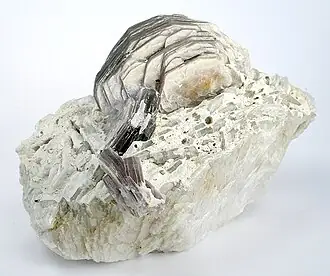
Lepidolite
Lithium-bearing mica in soft lilac, splitting into flexible sheets. Often intergrown with pink tourmaline in pegmatite pockets.
Mohs 2.5-3 · Lilac, Pink
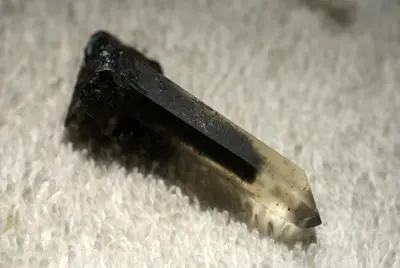
Quartz
Lodolite (Garden Quartz)
Clear quartz with mineral inclusions arranged into landscapes — mossy hills, undersea scenes, drifting clouds. Cutters orient the rough deliberately so that the interior scene reads through the polished face.
Mohs 7 · Clear, Green
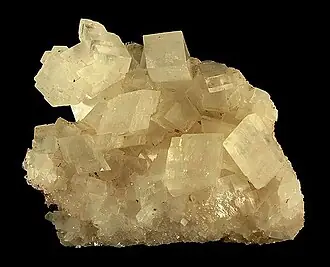
Carbonate
Magnesite
White magnesium carbonate, usually massive with a porcelain-like texture crossed by grey veining. Frequently dyed to imitate turquoise or lapis.
Mohs 3.5-4.5 · White, Cream
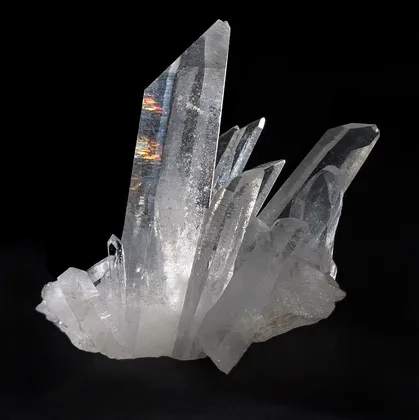
Quartz
Milky Quartz
Quartz clouded white by countless microscopic fluid inclusions trapped during growth. The most abundant form of crystalline quartz on the planet and the white vein rock of countless mountainsides.
Mohs 7 · White, Cream
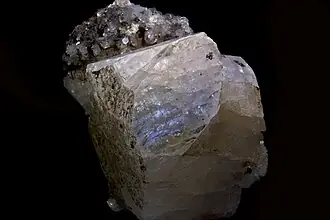
Feldspar
Moonstone
Orthoclase feldspar with a floating blue-white sheen called adularescence, caused by light scattering between microscopic layers of two feldspars.
Mohs 6-6.5 · White, Peach
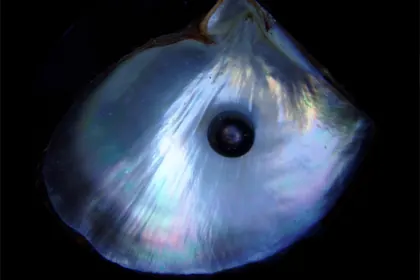
Organic
Mother of Pearl
The nacre lining of pearl oysters and freshwater mussels, cut into plates and cabochons. A soft silvery-white with a slow moving sheen rather than the hard flash of abalone.
Mohs 2.5-4 · White, Cream
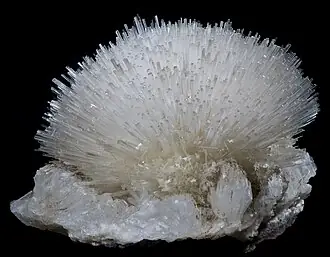
Zeolite
Natrolite
Needle-sharp radiating sprays of sodium zeolite, often clear enough to facet in small stones. It is the matrix mineral that hosts benitoite in California.
Mohs 5-5.5 · White, Colorless
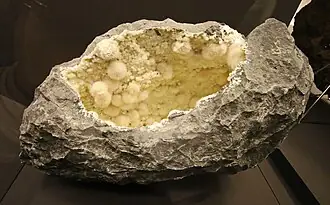
Zeolite-associated
Okenite
Puffball sprays of hair-fine white fibres sitting in basalt cavities — often described as cotton balls, and genuinely soft to the touch, since the fibres flex under a finger.
Mohs 4.5-5 · White, Cream
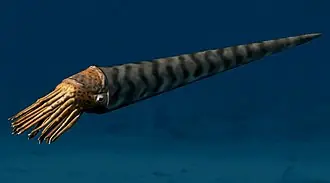
Fossil
Orthoceras
Straight-shelled cephalopods from the Devonian seas, now polished into black limestone plates that read like ink drawings.
Mohs 3-4 · Black, Grey
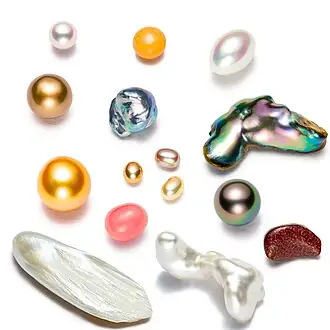
Organic
Pearl
Concentric nacre laid down by a mollusc around an irritant. Almost all pearls on the market are cultured; natural pearls are rare enough to be an auction category of their own.
Mohs 2.5-4 · White, Cream
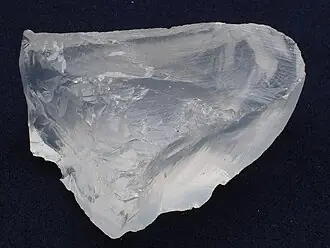
Silicate
Petalite
A lithium aluminium silicate with a soft, satiny character — usually colorless to pale pink, and one of the quiet stones people gravitate to without being able to say why.
Mohs 6-6.5 · Colorless, White
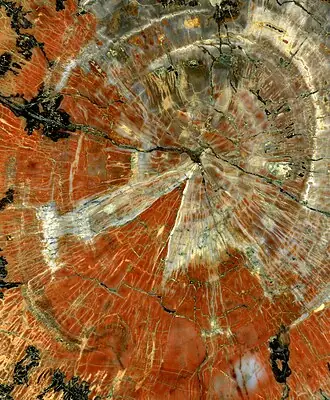
Fossil
Petrified Wood
Ancient wood in which every cell was replaced by silica, preserving growth rings, bark and even insect galleries in solid quartz.
Mohs 6.5-7 · Brown, Red
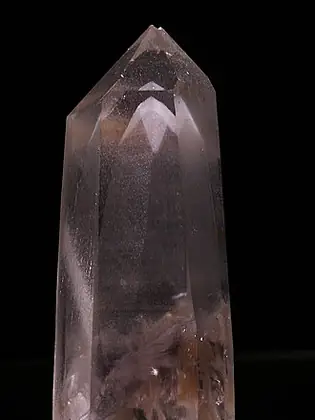
Quartz
Phantom Quartz
Quartz that paused during growth long enough for a film of chlorite, hematite or clay to settle on its faces, then resumed — leaving a ghost crystal sealed inside the finished one.
Mohs 7 · Colorless, Green
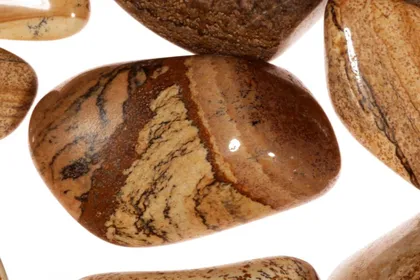
Chalcedony
Picture Jasper
Jasper whose iron staining and sediment layering read as desert landscapes — mesas, dunes, storm skies. Biggs and Bruneau material from the Pacific Northwest are the classics of the type.
Mohs 6.5-7 · Tan, Brown
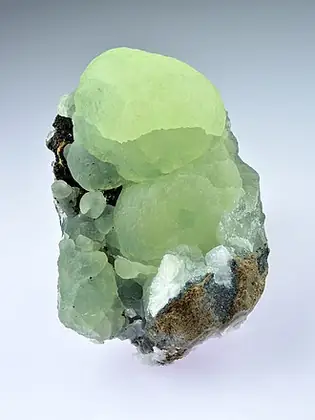
Silicate
Prehnite
Botryoidal green silicate with a soft grape-cluster surface, frequently hosting black epidote needles that make the best specimens.
Mohs 6-6.5 · Green, Yellow-green
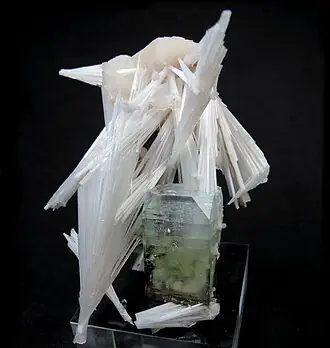
Zeolite
Scolecite
Fine needle-like white zeolite crystals that radiate in silky sprays, sometimes forming dense pillow-like masses.
Mohs 5-5.5 · White, Colorless
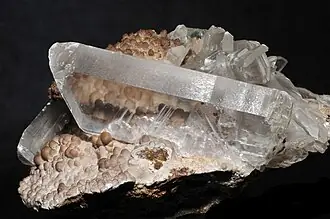
Gypsum
Selenite
A clear, satin or fibrous variety of gypsum that grows in blades, wands and — at Naica in Mexico — beams over ten metres long. Soft enough to scratch with a fingernail.
Mohs 2 · White, Colorless
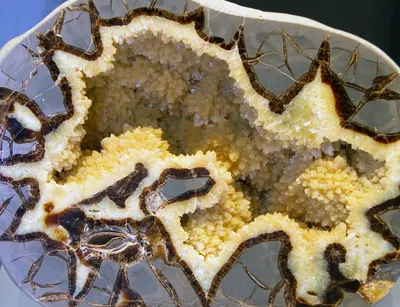
Concretion
Septarian Nodule
Mud concretions that dried and cracked internally, then had the cracks filled with golden calcite and brown aragonite — a fossil record of shrinkage roughly fifty million years old.
Mohs 3-4 · Yellow, Brown
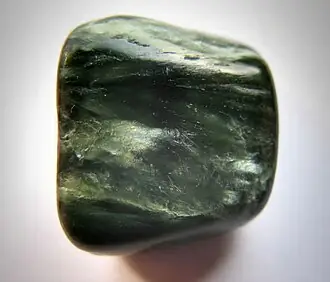
Chlorite
Seraphinite
A deep green clinochlore from one Siberian locality, shot through with silvery feather patterns that look like folded wings. Every piece comes from the Lake Baikal region; there is no second source.
Mohs 2-2.5 · Bottle green, Silver-green
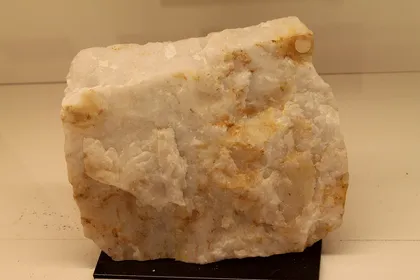
Quartz
Snow Quartz
Dense opaque white quartz, sometimes marketed as quartzite or milky quartz, cut into spheres and slabs for a clean matte white that holds light softly.
Mohs 7 · White, Cream
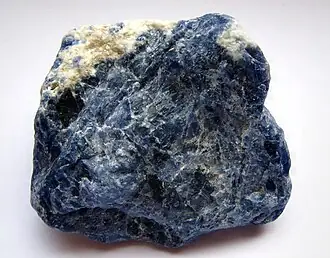
Feldspathoid
Sodalite
Royal blue feldspathoid streaked with white calcite veining. Often confused with lapis, but sodalite lacks pyrite and reads more violet.
Mohs 5.5-6 · Blue, White
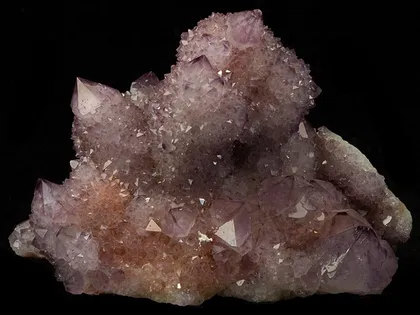
Quartz
Spirit Quartz
Amethyst or citrine points entirely encrusted with a coat of tiny second-generation crystals, so the wand bristles like frost. Found in commercial quantity in one district of South Africa.
Mohs 7 · Lavender, Violet
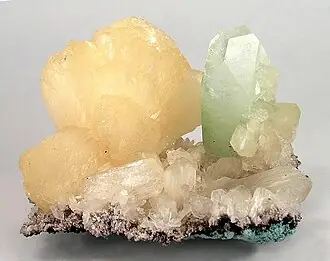
Zeolite
Stilbite
A zeolite that grows in peach-colored bowtie and sheaf-like sprays, most often alongside apophyllite in Indian basalt pockets.
Mohs 3.5-4 · Peach, White
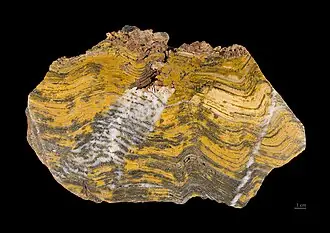
Fossil
Stromatolite
Layered structures built by cyanobacterial mats — the oldest evidence of life on earth, with examples running back 3.5 billion years. The wavy laminations polish into striking banded slabs.
Mohs 3-7 · Banded, Grey
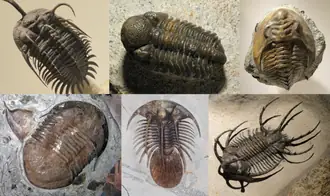
Fossil
Trilobite
Arthropods that ruled the sea floor for nearly 300 million years and left one of the best fossil records on earth. Moroccan Devonian species carry extravagant spines; Russian material from the Baltic is famously three-dimensional and glossy.
Mohs 3-6 · Brown, Black
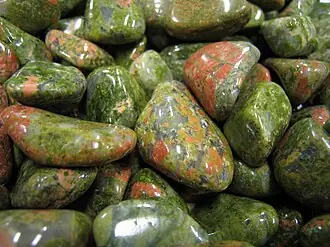
Granite
Unakite
An altered granite of pistachio epidote, salmon feldspar and clear quartz, named for the Unaka Range of the Appalachians.
Mohs 6-7 · Green, Pink
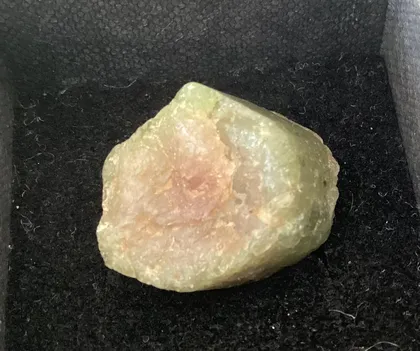
Tourmaline
Watermelon Tourmaline
Tourmaline zoned with a pink core and green rind, sliced across the prism to show the fruit-like cross-section that gives it its name.
Mohs 7-7.5 · Pink, Green
Please noteTraditional properties, effects, and aura associations are shared for cultural, historical, and personal-interest reasons only. They are folklore, not medicine. Nothing here is medical, psychological, or financial advice, and no stone is intended to diagnose, treat, cure, or prevent any condition. Please see a qualified professional for health concerns.