Silicate

Hemimorphite

Zinc silicate that forms both bladed crystal sprays and soft blue botryoidal crusts. The Chinese blue material is among the most beautiful secondary zinc minerals.
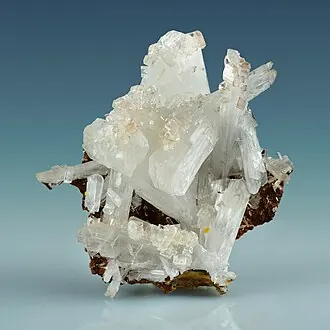
Hemimorphite — mineral specimen
Reference photograph: Wikimedia Commons · source. Specimens in the shop vary.

Judging quality

Look for saturated sky blue and either complete botryoidal surfaces or fans of transparent blades. Color should be consistent, not patchy.

Care

Fragile and moderately soft. Dust dry; avoid acids.

History & lore

Its name refers to its hemimorphic crystals, which are differently shaped at each end — a rare property that gives the mineral a natural electrical polarity.

Cultural history, recorded as tradition rather than as medical or scientific claim.

Common questions about Hemimorphite

What is Hemimorphite?
Zinc silicate that forms both bladed crystal sprays and soft blue botryoidal crusts. The Chinese blue material is among the most beautiful secondary zinc minerals.
How hard is Hemimorphite and what is it made of?
Hemimorphite is a Silicate-family mineral with the composition Zn4Si2O7(OH)2·H2O. It crystallizes in the orthorhombic system and rates 4.5-5 on the Mohs hardness scale. It occurs in blue, colorless, white.
Where does Hemimorphite come from?
Notable localities for Hemimorphite include China (Yunnan), Namibia, Mexico, USA.
How do you tell good Hemimorphite from filler?
Look for saturated sky blue and either complete botryoidal surfaces or fans of transparent blades. Color should be consistent, not patchy.
How do you care for Hemimorphite?
Fragile and moderately soft. Dust dry; avoid acids.

See it in person

Photographs only go so far

Both rooms are open six days a week, and there is always someone happy to pull pieces out of the case so you can compare them under the light.

Plan a visit
Share Hemimorphite