Judging quality
Gem silica shows translucent turquoise blue with a hard glassy polish; plain chrysocolla is chalky and easily marked with a fingernail. Peruvian material combines it with malachite and cuprite.
Silicate
A soft, hydrated copper silicate in vivid blue-green. On its own it is too fragile to work, so gem material is usually chrysocolla in chalcedony, called gem silica.
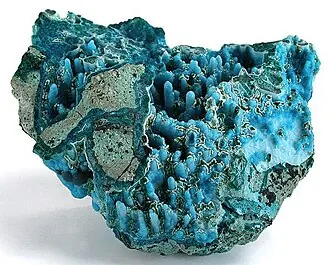
Gem silica shows translucent turquoise blue with a hard glassy polish; plain chrysocolla is chalky and easily marked with a fingernail. Peruvian material combines it with malachite and cuprite.
Very soft and porous unless silicified. Keep dry and away from oils.
The name comes from Greek for 'gold glue' — it was used as a flux in soldering gold.
Cultural history, recorded as tradition rather than as medical or scientific claim.
See it in person
Both rooms are open six days a week, and there is always someone happy to pull pieces out of the case so you can compare them under the light.