Judging quality
Prize saturated blue-green with crisp white perthite streaking and clean crystal form. Dull, chalky or heavily bleached material is common in tumbled goods.
Feldspar
Blue-green microcline feldspar, colored by trace lead. Colorado crystals grown alongside smoky quartz are among the most striking mineral specimens produced in North America.
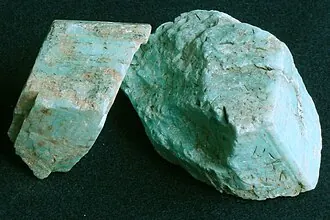
Prize saturated blue-green with crisp white perthite streaking and clean crystal form. Dull, chalky or heavily bleached material is common in tumbled goods.
Fades under prolonged sunlight. Two cleavage directions mean it chips easily.
Named for the Amazon River although no confirmed deposit has ever been found there — an eighteenth-century misattribution that stuck.
Cultural history, recorded as tradition rather than as medical or scientific claim.
See it in person
Both rooms are open six days a week, and there is always someone happy to pull pieces out of the case so you can compare them under the light.