Phyllosilicate

Apophyllite

Glassy pyramidal crystals that grow in the basalt cavities of the Deccan Traps, frequently perched on green stilbite or purple chalcedony.
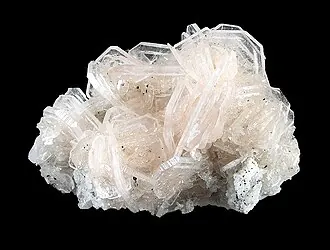
Apophyllite — mineral specimen
Reference photograph: Robert M. Lavinsky, CC BY-SA 3.0 · source. Specimens in the shop vary.

Judging quality

The finest Indian specimens have transparent, undamaged pyramid tips and attractive matrix association. Apophyllite tips chip easily, so intact points matter enormously.

Care

Soft with perfect basal cleavage. Never wash or handle by the crystal tips.

History & lore

Its name refers to how it flakes apart when heated, from Greek apo phyllizein, 'to leaf off'.

Cultural history, recorded as tradition rather than as medical or scientific claim.

Common questions about Apophyllite

What is Apophyllite?
Glassy pyramidal crystals that grow in the basalt cavities of the Deccan Traps, frequently perched on green stilbite or purple chalcedony.
How hard is Apophyllite and what is it made of?
Apophyllite is a Phyllosilicate-family mineral with the composition KCa4Si8O20(F,OH)·8H2O. It crystallizes in the tetragonal system and rates 4.5-5 on the Mohs hardness scale. It occurs in colorless, green, white.
Where does Apophyllite come from?
Notable localities for Apophyllite include India (Poona/Jalgaon), Brazil, Iceland.
How do you tell good Apophyllite from filler?
The finest Indian specimens have transparent, undamaged pyramid tips and attractive matrix association. Apophyllite tips chip easily, so intact points matter enormously.
How do you care for Apophyllite?
Soft with perfect basal cleavage. Never wash or handle by the crystal tips.

See it in person

Photographs only go so far

Both rooms are open six days a week, and there is always someone happy to pull pieces out of the case so you can compare them under the light.

Plan a visit
Share Apophyllite