Zeolite

Heulandite

Tabular zeolite crystals in coffin-shaped plates, often orange-peach and frequently mistaken for stilbite, with which it shares its Indian localities.
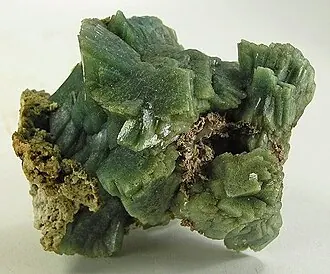
Heulandite — mineral specimen
Reference photograph: Robert M. Lavinsky, CC BY-SA 3.0 · source. Specimens in the shop vary.

Judging quality

Heulandite forms flat plates; stilbite forms sheaves. Look for pearly cleavage faces and clean crystal edges.

Care

Soft and water-sensitive. Dust with a dry brush.

History & lore

Zeolites are industrially vital as molecular sieves and water softeners, a use derived from their open cage-like structures.

Cultural history, recorded as tradition rather than as medical or scientific claim.

Common questions about Heulandite

What is Heulandite?
Tabular zeolite crystals in coffin-shaped plates, often orange-peach and frequently mistaken for stilbite, with which it shares its Indian localities.
How hard is Heulandite and what is it made of?
Heulandite is a Zeolite-family mineral with the composition (Ca,Na)2-3Al3(Al,Si)2Si13O36·12H2O. It crystallizes in the monoclinic system and rates 3-3.5 on the Mohs hardness scale. It occurs in peach, white, green.
Where does Heulandite come from?
Notable localities for Heulandite include India, Iceland, Brazil.
How do you tell good Heulandite from filler?
Heulandite forms flat plates; stilbite forms sheaves. Look for pearly cleavage faces and clean crystal edges.
How do you care for Heulandite?
Soft and water-sensitive. Dust with a dry brush.

See it in person

Photographs only go so far

Both rooms are open six days a week, and there is always someone happy to pull pieces out of the case so you can compare them under the light.

Plan a visit
Share Heulandite