The crystal encyclopedia
67 of 218
Appetite, creativity, pleasure and the making of things.
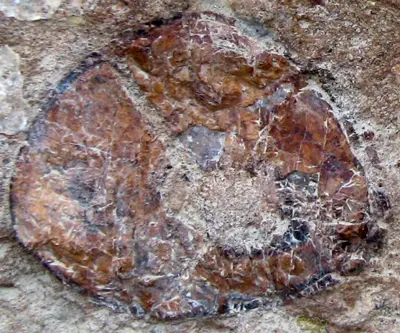
Fossil
Agatised Dinosaur Bone
Jurassic sauropod bone in which the marrow cells have been replaced cell by cell with agate and jasper — 'gembone'. The best Utah material shows red and yellow cells outlined in black, holding a mirror polish.
Mohs 6.5-7 · Red, Yellow
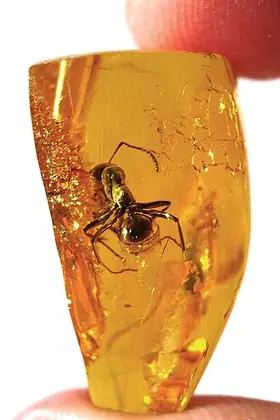
Organic
Amber
Tree resin fossilised over 30 to 100 million years. Baltic amber runs butterscotch to cognac; Dominican material can be transparent blue under daylight; Burmese burmite is the oldest at roughly 99 million years and is the amber most often carrying insect inclusions.
Mohs 2-2.5 · Amber, Honey
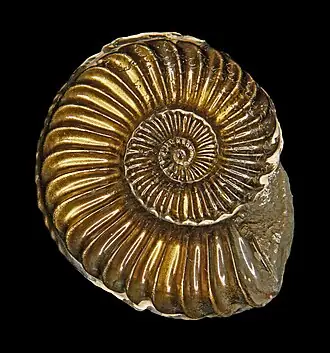
Fossil
Ammonite
The coiled shells of cephalopods that vanished with the dinosaurs. Ammolite, the iridescent Albertan variety, is one of only a handful of organic gemstones.
Mohs 3.5-4 · Brown, Iridescent
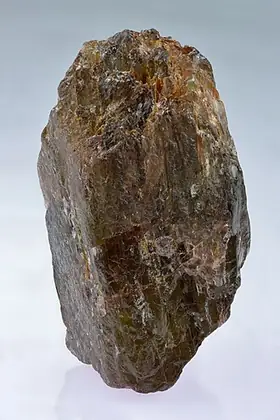
Silicate
Andalusite
A strongly pleochroic gem that shows green, gold and red-brown simultaneously from different directions — cutters deliberately orient it to display all three at once rather than trying to eliminate them.
Mohs 7-7.5 · Olive green, Brown
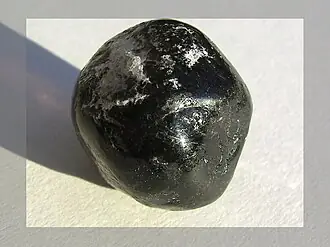
Volcanic glass
Apache Tears
Rounded nodules of obsidian weathered free from the white perlite that once enclosed them. Held to a light they glow smoky translucent brown at the edges.
Mohs 5-5.5 · Black, Brown
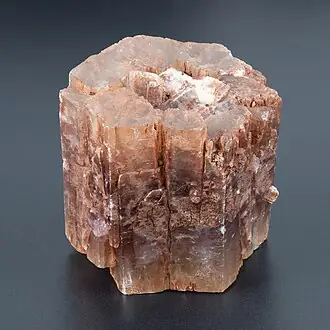
Carbonate
Aragonite
Chemically identical to calcite but with a different crystal structure, aragonite grows in radiating sputnik clusters, coral-like sprays and the nacre of shells.
Mohs 3.5-4 · Brown, Orange
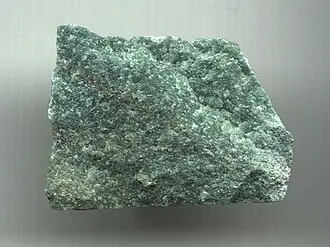
Quartz
Aventurine
Quartzite spangled with reflective mica platelets — green from fuchsite, blue from dumortierite. The shimmer is called aventurescence.
Mohs 6.5-7 · Green, Blue
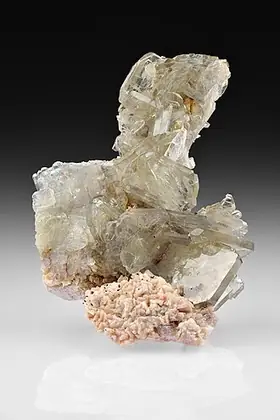
Sulfate
Barite
Unusually heavy for a pale mineral — its high barium content makes barite feel like metal in the hand. Grows in blades, roses and elegant tabular crystals.
Mohs 3-3.5 · White, Blue
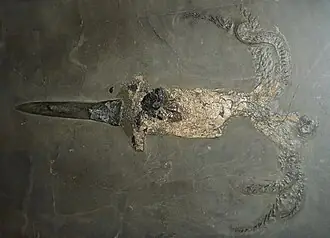
Fossil
Belemnite
The bullet-shaped internal skeleton of an extinct squid relative. Cut and polished, the calcite shows a radiating fibrous structure from a central apical line.
Mohs 3-4 · Brown, Amber
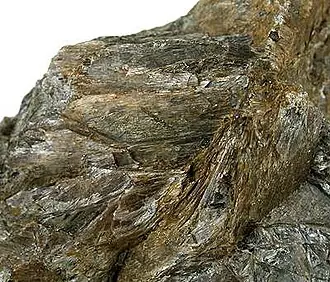
Pyroxene
Bronzite
Enstatite with enough iron to develop a warm metallic bronze sheen across the cleavage planes. Usually cut as cabochons or beads, sometimes intergrown with green serpentine.
Mohs 5-6 · Bronze, Brown
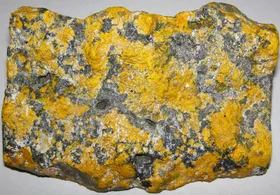
Sedimentary
Bumblebee Stone
Banded yellow, orange and black material from a live volcanic fumarole field in Java. Sold as 'bumblebee jasper', but it is not a jasper at all — it is volcanic sediment cemented with sulfur, calcite and arsenic minerals.
Mohs 4-5 · Yellow, Black
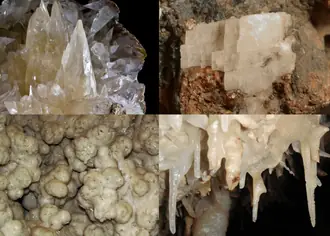
Carbonate
Calcite
One of the most polymorphic minerals known, with hundreds of crystal habits and every color of the spectrum. Optical calcite from Iceland splits an image in two through double refraction.
Mohs 3 · Orange, Honey
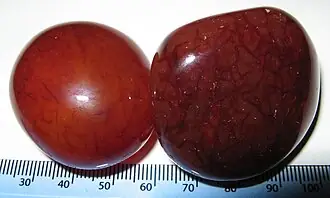
Chalcedony
Carnelian
Translucent orange to deep red chalcedony colored by iron oxide. Warm, glowing and tough, it has been one of the world's favourite carving stones for millennia.
Mohs 6.5-7 · Orange, Red
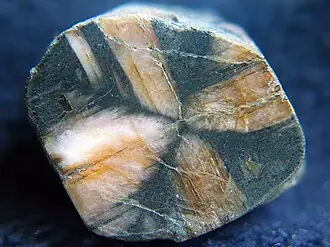
Silicate
Chiastolite
Andalusite grown with graphite inclusions arranged in a dark cross that appears when the crystal is sliced across. Every cross is slightly different, and the best show four crisp arms with no smearing.
Mohs 6.5-7.5 · Brown, Black
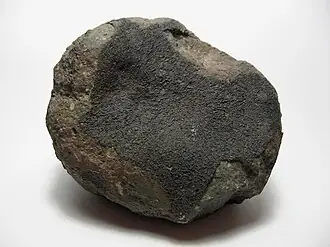
Meteorite
Chondrite Meteorite
The most common meteorite type and the oldest rock anyone can hold: stony material containing chondrules, millimetre droplets of melt that condensed 4.56 billion years ago before the planets existed.
Mohs 5-6 · Grey, Brown
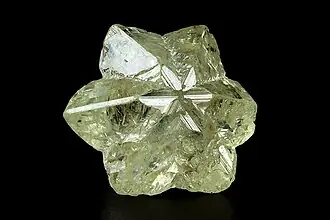
Oxide
Chrysoberyl
The third hardest gem mineral after diamond and corundum, and badly underrated. Ordinary chrysoberyl is a crisp yellow-green; the cat's eye variety cymophane shows a razor-sharp band of light from fine parallel inclusions.
Mohs 8.5 · Yellow-green, Golden
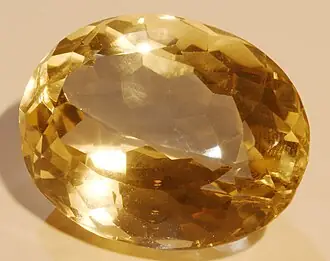
Quartz
Citrine
Yellow to golden quartz. Genuinely natural citrine is uncommon and tends toward a smoky lemon or champagne tone; the vivid orange 'burnt' material widely sold is heat-treated amethyst, which is a legitimate product but a different thing entirely.
Mohs 7 · Yellow, Golden
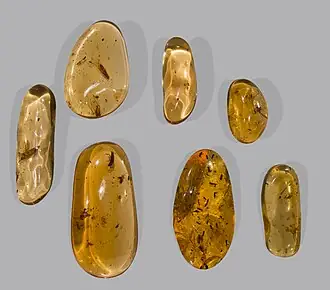
Organic
Copal
Young tree resin, typically a few thousand to a few million years old — geologically an amber in progress. Colombian copal is bright, glassy and often crowded with recent insect inclusions, which is why it is so frequently sold as amber.
Mohs 1.5-2 · Golden, Pale yellow
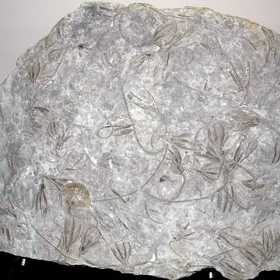
Fossil
Crinoid
Sea lilies — stalked echinoderms that carpeted Palaeozoic sea beds. Most material is disarticulated stem segments in limestone; complete crowns with the feeding arms intact are dramatically rarer and prepared over many hours.
Mohs 3-4 · Cream, Tan
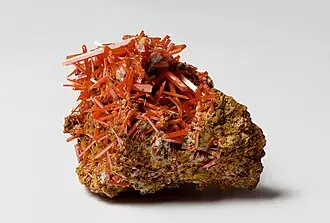
Chromate
Crocoite
Tangerine-orange lead chromate in hollow sprays of hair-fine prisms. Tasmanian Dundas material is the world standard and among the most photographed minerals in existence.
Mohs 2.5-3 · Orange, Red
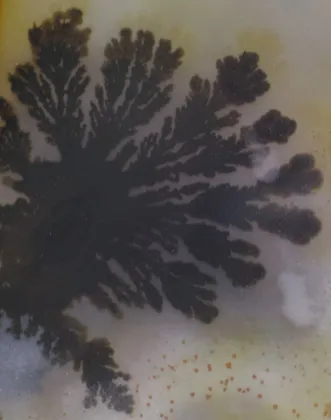
Chalcedony
Dendritic Agate
Translucent chalcedony containing black fern-like dendrites of manganese oxide that look exactly like plants but are pure mineral growth along fractures.
Mohs 6.5-7 · White, Colorless
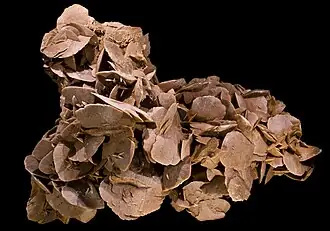
Gypsum
Desert Rose
Rosette clusters of gypsum or barite that grow in arid basins, trapping sand grains between their blades so each 'petal' carries the color of the desert it formed in.
Mohs 2 · Sand, Tan
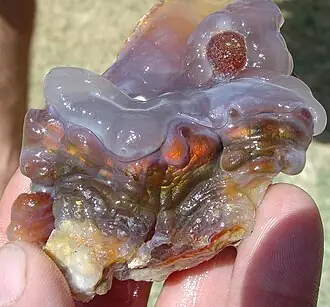
Chalcedony
Fire Agate
Chalcedony containing microscopically thin layers of iron oxide that create iridescent fire — reds, greens and golds — trapped inside the stone. Cutting it is a specialist skill: the cutter must chase the fire layer without going through it.
Mohs 6.5-7 · Brown, Red
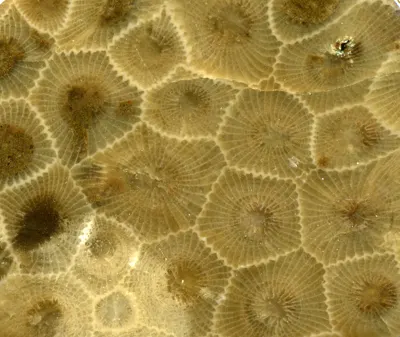
Fossil
Fossil Coral
Colonial coral replaced by agate or chalcedony, preserving the flower-like corallite pattern as a permanent stone. Florida agatised coral shows crisp white florets in grey; Petoskey stone from Michigan is a Devonian rugose coral polished to a honeycomb.
Mohs 6.5-7 · Tan, Grey
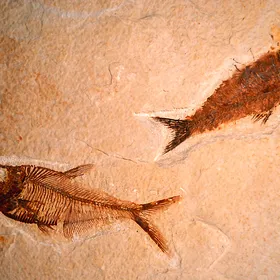
Fossil
Fossil Fish
Eocene lake fish from the Green River Formation — Knightia, Diplomystus, Phareodus — preserved whole with fins and scales in fine laminated limestone. Lebanese Cretaceous material is marine and older.
Mohs 3-4 · Brown, Cream
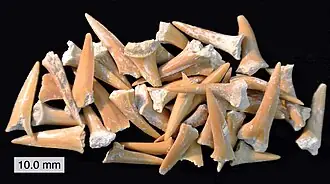
Fossil
Fossil Shark Tooth
Sharks shed teeth continuously, which is why they are the most abundant vertebrate fossil on earth. Color comes from the minerals in the burial sediment — river-tumbled Florida teeth run jet black, Moroccan phosphate teeth tan and grey.
Mohs 4.5-5 · Black, Grey
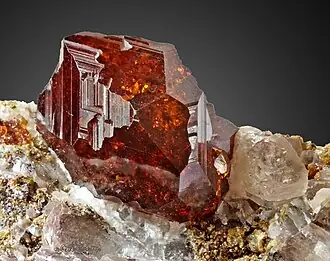
Garnet group
Garnet
A family of related silicates rather than one mineral, spanning almandine red, tsavorite green, spessartine orange and color-changing pyrope-spessartine. Crystals grow as dodecahedra with striking geometric perfection.
Mohs 6.5-7.5 · Red, Green
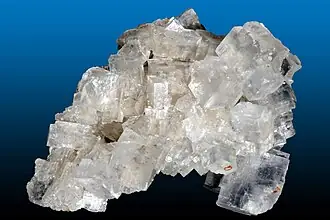
Halide
Halite
Rock salt, crystallising in perfect cubes — sometimes hopper-shaped with stepped hollow faces. Rare blue halite from German potash mines gets its color from lattice defects, not impurities.
Mohs 2-2.5 · Colorless, Pink
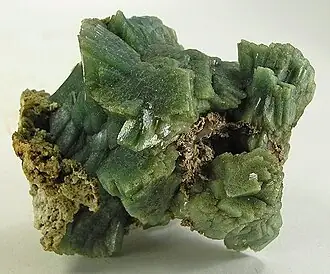
Zeolite
Heulandite
Tabular zeolite crystals in coffin-shaped plates, often orange-peach and frequently mistaken for stilbite, with which it shares its Indian localities.
Mohs 3-3.5 · Peach, White
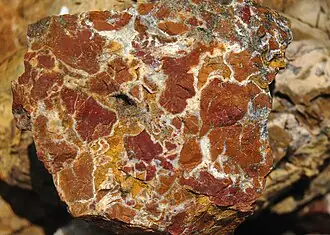
Chalcedony
Jasper
Opaque microcrystalline quartz colored by iron and clay impurities. Jasper is a family rather than a single stone, and named varieties — ocean, picture, mookaite, bumblebee — often come from a single deposit.
Mohs 6.5-7 · Red, Yellow
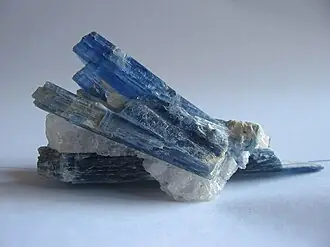
Silicate
Kyanite
A remarkable mineral with two different hardnesses in one crystal: about 4.5 along the blade and 7 across it. Blue blades from Brazil and Nepal are the classic specimen.
Mohs 4.5-7 · Blue, Black
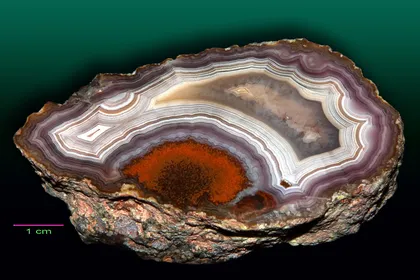
Chalcedony
Laguna Agate
Widely considered the finest banded agate on earth: tight, high-contrast red and white fortification banding from one ranch in Chihuahua. Collector-grade nodules are sold by name and by pattern.
Mohs 6.5-7 · Red, Orange
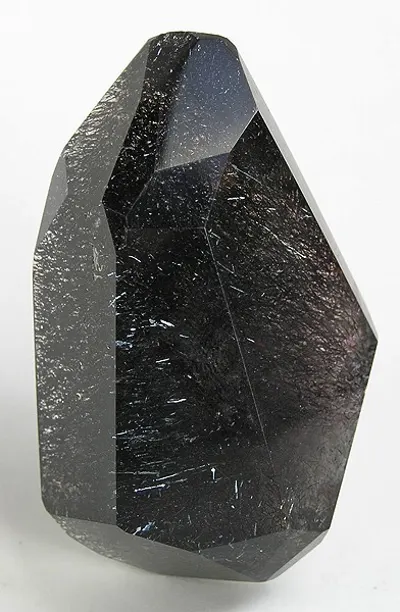
Quartz
Lepidocrocite in Quartz
Clear or amethystine quartz hosting fans of red-orange lepidocrocite blades, often in super-seven and 'harlequin' combinations from Madagascar.
Mohs 7 · Red, Orange
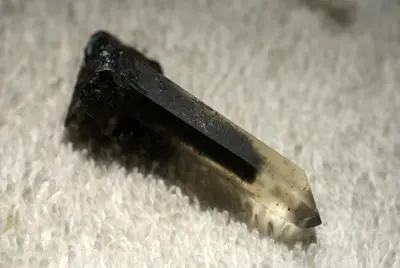
Quartz
Lodolite (Garden Quartz)
Clear quartz with mineral inclusions arranged into landscapes — mossy hills, undersea scenes, drifting clouds. Cutters orient the rough deliberately so that the interior scene reads through the polished face.
Mohs 7 · Clear, Green
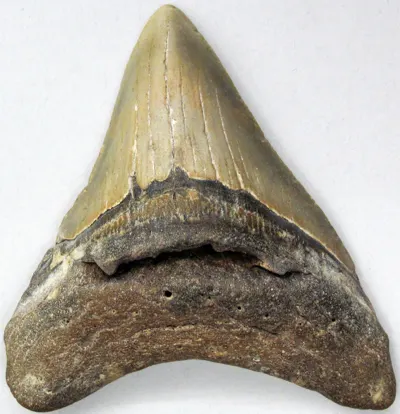
Fossil
Megalodon Tooth
The tooth of Otodus megalodon, the largest shark that ever lived, extinct around 3.6 million years ago. Teeth run from palm-sized to over seven inches; every extra half inch above five is a substantial jump in rarity and price.
Mohs 4.5-5 · Black, Grey
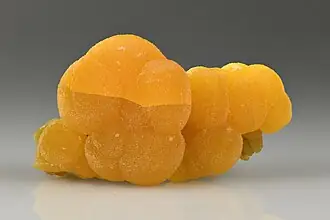
Arsenate
Mimetite
Lead arsenate that grows as glassy yellow barrel crystals or as botryoidal 'campylite' spheres. The Mexican Mapimí material, in warm marigold rounds, is the one most often seen.
Mohs 3.5-4 · Yellow, Orange
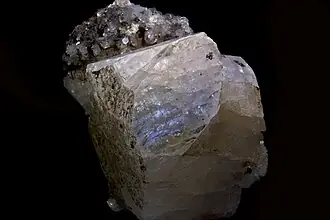
Feldspar
Moonstone
Orthoclase feldspar with a floating blue-white sheen called adularescence, caused by light scattering between microscopic layers of two feldspars.
Mohs 6-6.5 · White, Peach
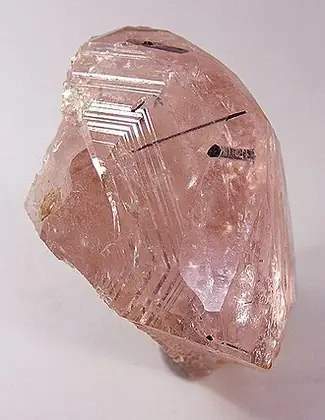
Beryl
Morganite
Pink to peach beryl colored by manganese. Crystals tend to be tabular rather than long, and the softest apricot tones are the most characteristic.
Mohs 7.5-8 · Peach, Pink
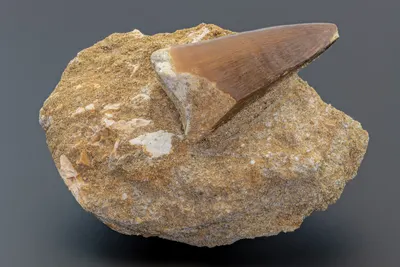
Fossil
Mosasaur Tooth
The conical, ridged tooth of a Cretaceous marine reptile — a lizard that returned to the sea and grew to seventeen metres. Moroccan phosphate beds supply most of the market, often with root and jaw section intact.
Mohs 4.5-5 · Brown, Black
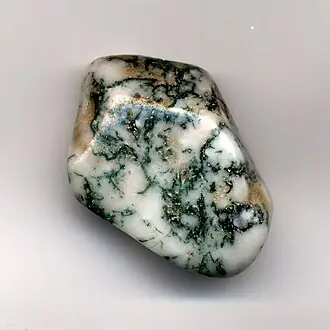
Chalcedony
Moss Agate
Translucent chalcedony filled with dendritic mineral growths that look like moss, ferns or distant trees. Not banded, so technically not a true agate.
Mohs 6.5-7 · Green, Colorless
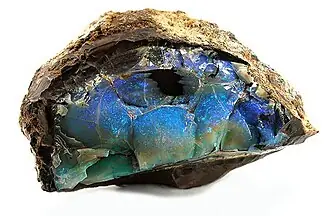
Mineraloid
Opal
Hydrated silica whose spheres diffract light into shifting play-of-color. Black opal from Lightning Ridge is the most valuable; Ethiopian Welo opal is the great recent discovery.
Mohs 5.5-6.5 · Play-of-color, White
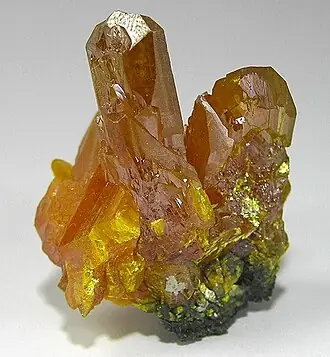
Sulfide
Orpiment
Arsenic trisulfide in sheaves of golden foliated blades with a resinous to pearly flash. It usually grows alongside realgar, the pair making one of the most striking red-and-gold associations in mineralogy.
Mohs 1.5-2 · Golden, Yellow
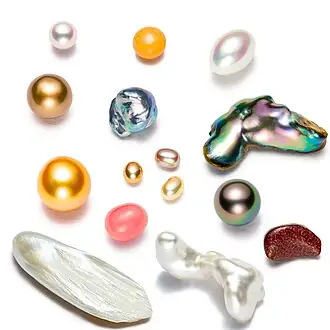
Organic
Pearl
Concentric nacre laid down by a mollusc around an irritant. Almost all pearls on the market are cultured; natural pearls are rare enough to be an auction category of their own.
Mohs 2.5-4 · White, Cream
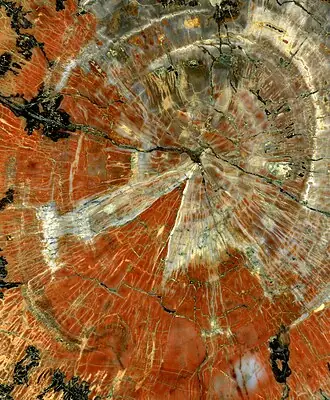
Fossil
Petrified Wood
Ancient wood in which every cell was replaced by silica, preserving growth rings, bark and even insect galleries in solid quartz.
Mohs 6.5-7 · Brown, Red
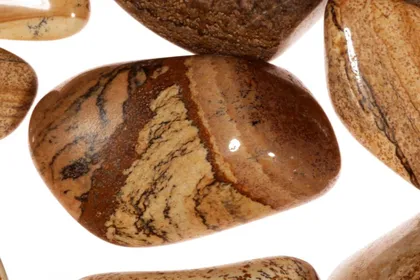
Chalcedony
Picture Jasper
Jasper whose iron staining and sediment layering read as desert landscapes — mesas, dunes, storm skies. Biggs and Bruneau material from the Pacific Northwest are the classics of the type.
Mohs 6.5-7 · Tan, Brown
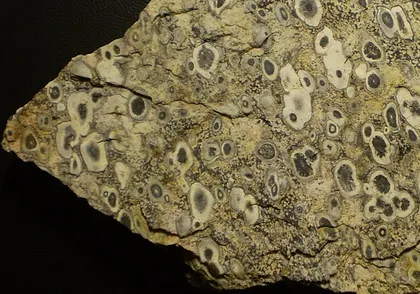
Igneous
Rainforest Rhyolite
Green and cream orbicular rhyolite, sometimes called rainforest jasper, patterned by epidote and quartz-filled gas pockets in an old lava flow.
Mohs 6-7 · Green, Olive green
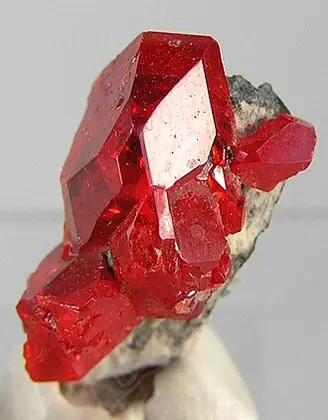
Sulfide
Realgar
Arsenic sulfide in a translucent orange-red that looks like carved candy. Chinese crystals from Shimen are the finest ever found and are stored in the dark to preserve them.
Mohs 1.5-2 · Red, Orange
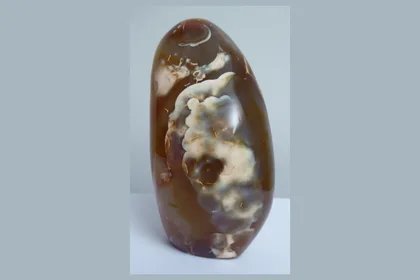
Chalcedony
Sardonyx
Straight-banded chalcedony alternating reddish-brown sard with white — the classic cameo material, because a carver can cut through the pale layer to reveal the dark one beneath.
Mohs 6.5-7 · Red, White
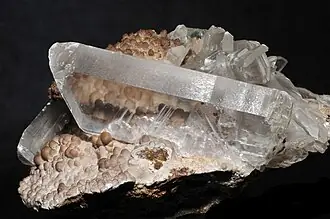
Gypsum
Selenite
A clear, satin or fibrous variety of gypsum that grows in blades, wands and — at Naica in Mexico — beams over ten metres long. Soft enough to scratch with a fingernail.
Mohs 2 · White, Colorless
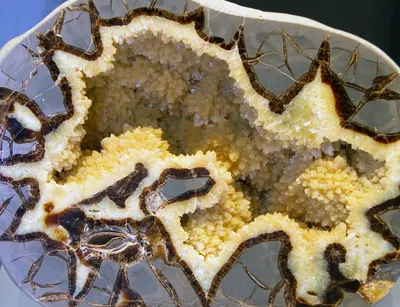
Concretion
Septarian Nodule
Mud concretions that dried and cracked internally, then had the cracks filled with golden calcite and brown aragonite — a fossil record of shrinkage roughly fifty million years old.
Mohs 3-4 · Yellow, Brown
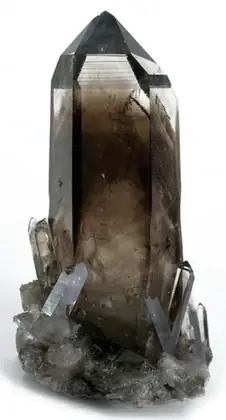
Quartz
Smoky Quartz
Quartz darkened from grey to near-black by natural irradiation of aluminium impurities. Alpine smoky quartz from Swiss and Austrian clefts is among the most sought-after crystal in the world; Scottish cairngorm has been set into ceremonial dress for centuries.
Mohs 7 · Brown, Grey
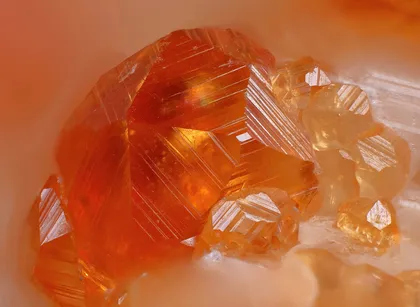
Garnet
Spessartine Garnet
Manganese garnet in a vivid mandarin orange. Namibian material from the Kunene River gave the trade name 'mandarin garnet' in the 1990s; Chinese crystals from Fujian are collectors' pieces on smoky quartz matrix.
Mohs 7-7.5 · Orange, Amber
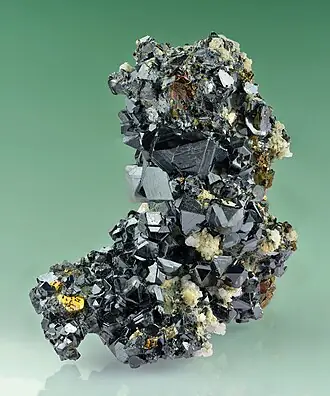
Sulfide
Sphalerite
Zinc sulfide with a dispersion three times higher than diamond, which makes cut honey-colored Spanish sphalerite one of the most fiery gemstones that exists.
Mohs 3.5-4 · Honey, Red
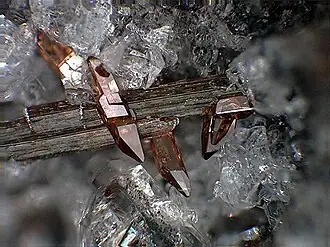
Silicate
Sphene (Titanite)
Titanite, better known as sphene, has dispersion higher than diamond, throwing intense rainbow fire from every cut surface.
Mohs 5-5.5 · Green, Yellow
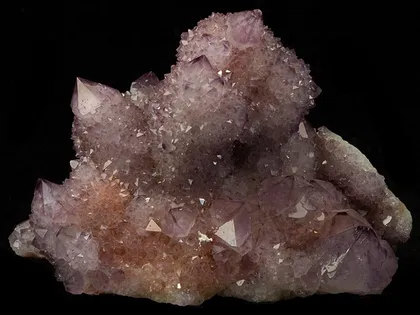
Quartz
Spirit Quartz
Amethyst or citrine points entirely encrusted with a coat of tiny second-generation crystals, so the wand bristles like frost. Found in commercial quantity in one district of South Africa.
Mohs 7 · Lavender, Violet
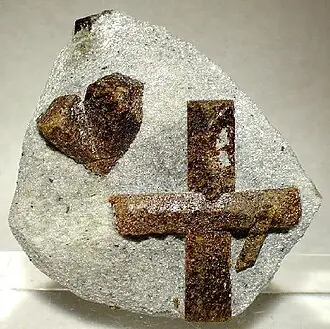
Silicate
Staurolite
Iron aluminium silicate famous for twinning into natural crosses — some at ninety degrees, some at sixty. Russian Kola material gives the crispest right-angle crosses.
Mohs 7-7.5 · Brown, Clove brown
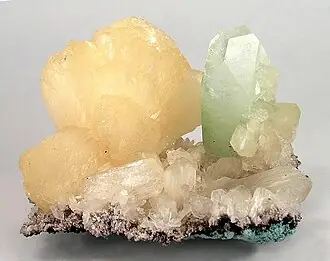
Zeolite
Stilbite
A zeolite that grows in peach-colored bowtie and sheaf-like sprays, most often alongside apophyllite in Indian basalt pockets.
Mohs 3.5-4 · Peach, White
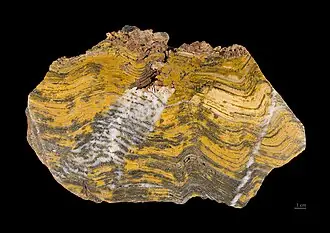
Fossil
Stromatolite
Layered structures built by cyanobacterial mats — the oldest evidence of life on earth, with examples running back 3.5 billion years. The wavy laminations polish into striking banded slabs.
Mohs 3-7 · Banded, Grey
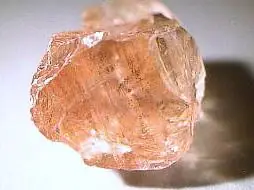
Feldspar
Sunstone
Feldspar with a glittering aventurescence from platelets of copper or hematite. Oregon sunstone is unusual in being colored by native copper, producing transparent red and green gems.
Mohs 6-6.5 · Orange, Red
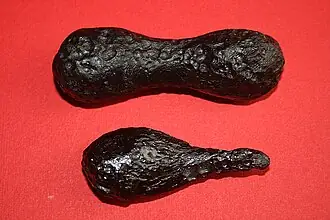
Impactite
Tektite
Terrestrial rock melted and flung into the atmosphere by a large impact, then frozen into glass as it fell. Indochinite tektites carry deep sculpted grooves; australites can retain aerodynamic flanges from atmospheric re-entry.
Mohs 5-6 · Black, Brown
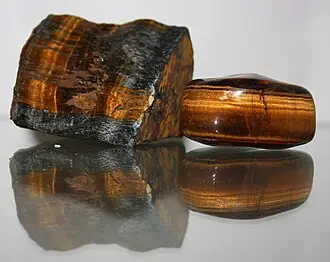
Quartz
Tiger's Eye
Quartz that replaced fibrous crocidolite, inheriting its parallel structure and producing a rolling band of light called chatoyancy. Blue hawk's eye is the unoxidised form.
Mohs 6.5-7 · Gold, Brown
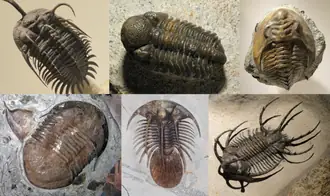
Fossil
Trilobite
Arthropods that ruled the sea floor for nearly 300 million years and left one of the best fossil records on earth. Moroccan Devonian species carry extravagant spines; Russian material from the Baltic is famously three-dimensional and glossy.
Mohs 3-6 · Brown, Black
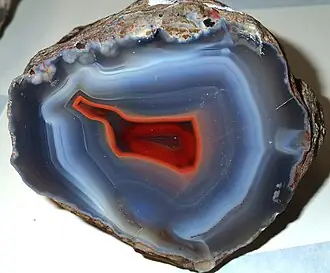
Chalcedony
Turritella Agate
Dark brown agate packed with the spiral shells of freshwater snails — properly Elimia tenera, not Turritella, but the trade name stuck a century ago. Cut faces show the spirals in cross-section like a mosaic.
Mohs 6.5-7 · Brown, Black
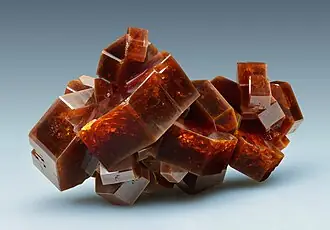
Vanadate
Vanadinite
Brilliant red-orange hexagonal crystals that grow on barite matrix in the lead deposits of Morocco. Few minerals are so intensely colored.
Mohs 3-4 · Red, Orange
Silicate
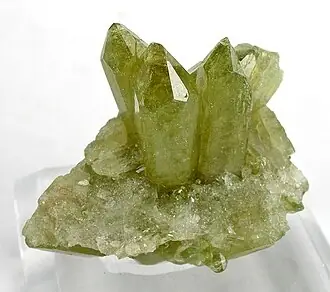
Vesuvianite
Also called idocrase. Stubby tetragonal prisms in bottle green to olive, with a resinous lustre; the Jeffrey Mine in Quebec produced the finest gem crystals ever found before it closed.
Mohs 6-7 · Green, Olive green
Molybdate
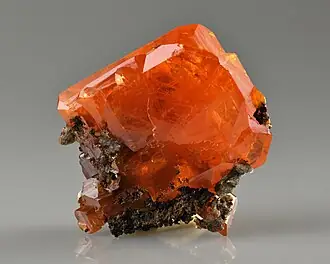
Wulfenite
Thin tabular crystals like stained glass windows, ranging from butterscotch yellow to the legendary deep red of Arizona's Red Cloud Mine.
Mohs 2.75-3 · Orange, Yellow
Silicate
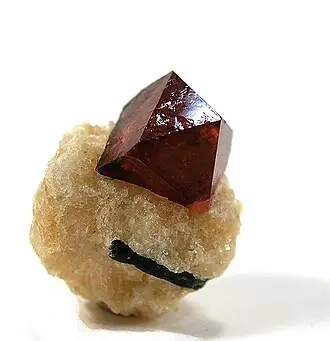
Zircon
A genuinely brilliant natural gem with dispersion approaching diamond, and quite unrelated to cubic zirconia despite the name confusion. Cambodian material is heat-treated to the familiar electric blue; natural stones run honey, red and brown.
Mohs 6-7.5 · Blue, Golden
Please noteTraditional properties, effects, and aura associations are shared for cultural, historical, and personal-interest reasons only. They are folklore, not medicine. Nothing here is medical, psychological, or financial advice, and no stone is intended to diagnose, treat, cure, or prevent any condition. Please see a qualified professional for health concerns.