Judging quality
Hold to the light: fine carnelian glows evenly with a soft internal fire. Much commercial material is dyed and heated agate, betrayed by uneven color along banding.
Chalcedony
Translucent orange to deep red chalcedony colored by iron oxide. Warm, glowing and tough, it has been one of the world's favourite carving stones for millennia.
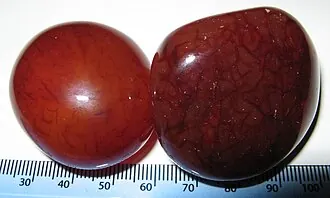
Hold to the light: fine carnelian glows evenly with a soft internal fire. Much commercial material is dyed and heated agate, betrayed by uneven color along banding.
Very durable; soap and water is fine. Deep color is stable.
Carnelian signet rings were the standard seal stone of the Roman world because hot wax does not stick to it.
Cultural history, recorded as tradition rather than as medical or scientific claim.
See it in person
Both rooms are open six days a week, and there is always someone happy to pull pieces out of the case so you can compare them under the light.