Judging quality
Look for a sharp, mobile chatoyant band and rich honey color. Dyed red and blue-green tiger's eye is common and obvious against the natural gold, brown and slate-blue range.
Quartz
Quartz that replaced fibrous crocidolite, inheriting its parallel structure and producing a rolling band of light called chatoyancy. Blue hawk's eye is the unoxidised form.
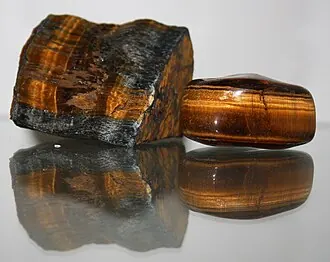
Look for a sharp, mobile chatoyant band and rich honey color. Dyed red and blue-green tiger's eye is common and obvious against the natural gold, brown and slate-blue range.
Durable. Soap and water; color is stable in natural material.
The Northern Cape's Doornrivier deposits have supplied most of the world's tiger's eye for over a century.
Cultural history, recorded as tradition rather than as medical or scientific claim.
See it in person
Both rooms are open six days a week, and there is always someone happy to pull pieces out of the case so you can compare them under the light.