Judging quality
Look for fine, tight, well-defined banding and honest color. Bright turquoise, magenta and neon agate slices are dyed; natural colors are earth tones, greys, blues and translucent whites.
Chalcedony
Banded chalcedony, formed as silica-rich fluid seeped in layers into volcanic cavities. Every agate is a cross-section of its own slow filling, which is why no two slices repeat.
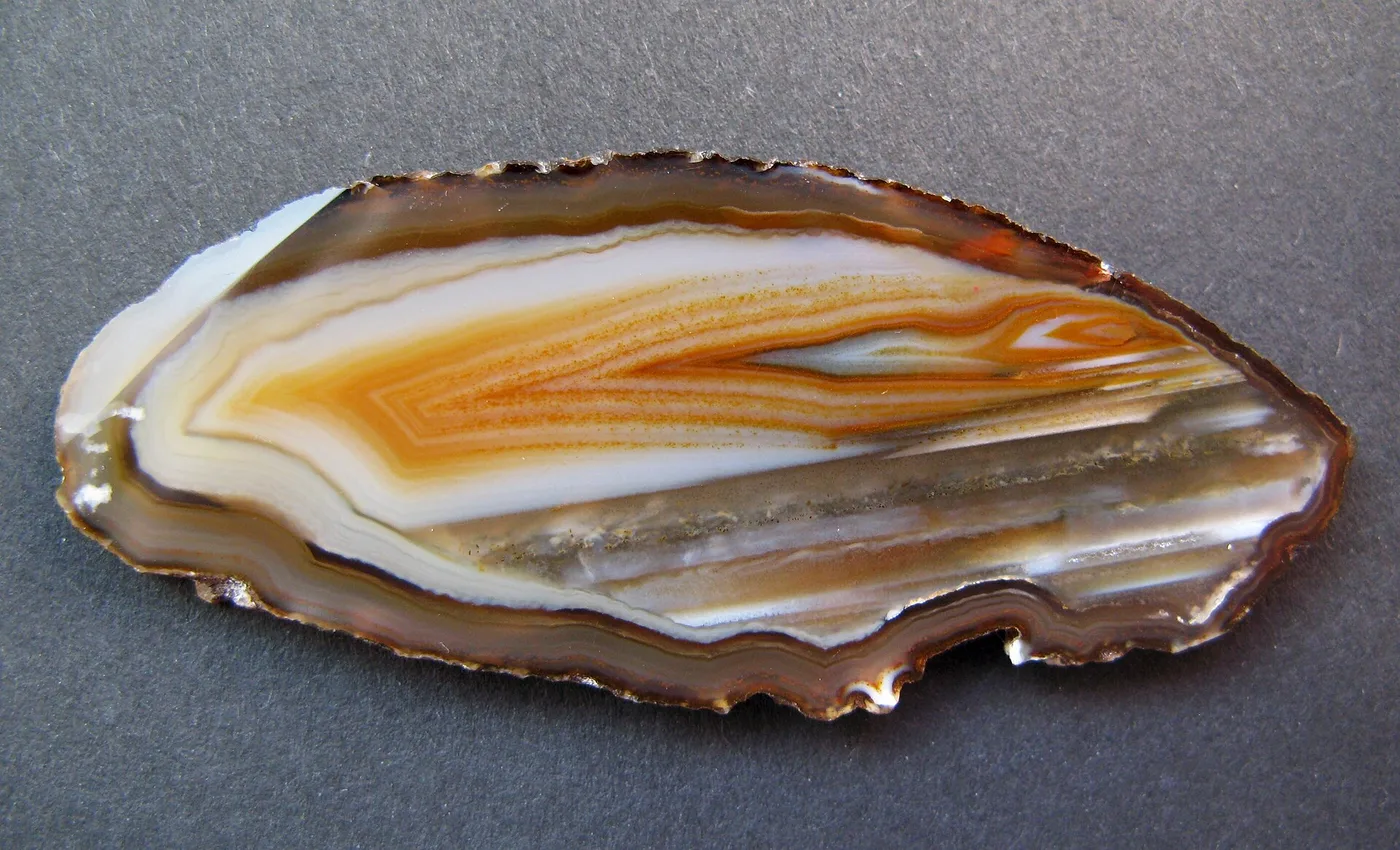
Look for fine, tight, well-defined banding and honest color. Bright turquoise, magenta and neon agate slices are dyed; natural colors are earth tones, greys, blues and translucent whites.
Very durable. Wash with soap and water; polished faces can be re-buffed.
Idar-Oberstein in Germany has cut agate continuously since the 1400s and gave the world much of modern lapidary technique.
Cultural history, recorded as tradition rather than as medical or scientific claim.
See it in person
Both rooms are open six days a week, and there is always someone happy to pull pieces out of the case so you can compare them under the light.