The crystal encyclopedia
27 of 218
Labradorite, opal, rainbow material — stones that read as every band at once.
Organic
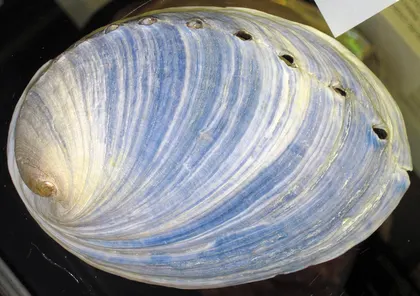
Abalone Shell
The nacreous inner shell of the abalone sea snail, layered aragonite platelets that scatter light into peacock blues and greens. New Zealand paua is the most saturated; California red abalone runs pink and silver.
Mohs 3.5-4 · Iridescent, Blue-green
Chalcedony
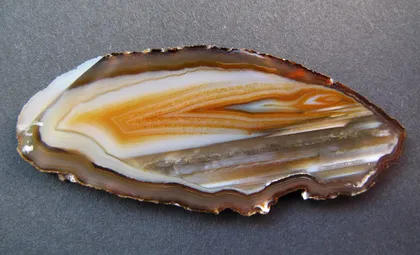
Agate
Banded chalcedony, formed as silica-rich fluid seeped in layers into volcanic cavities. Every agate is a cross-section of its own slow filling, which is why no two slices repeat.
Mohs 6.5-7 · Banded, Grey
Fossil
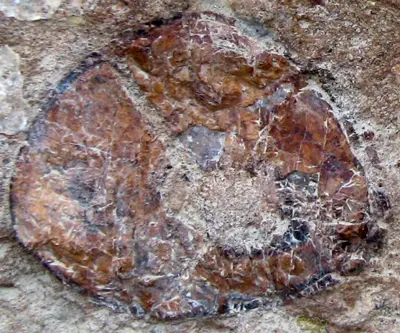
Agatised Dinosaur Bone
Jurassic sauropod bone in which the marrow cells have been replaced cell by cell with agate and jasper — 'gembone'. The best Utah material shows red and yellow cells outlined in black, holding a mirror polish.
Mohs 6.5-7 · Red, Yellow
Fossil
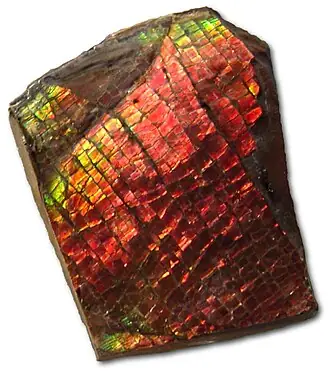
Ammolite
The iridescent nacre of Cretaceous ammonites from a single formation in southern Alberta — one of only a handful of biogenic gemstones. Color runs from common red and green through the far rarer blue and violet, in dragon-skin, ribbon or sheet patterns.
Mohs 3.5-4.5 · Iridescent, Rainbow
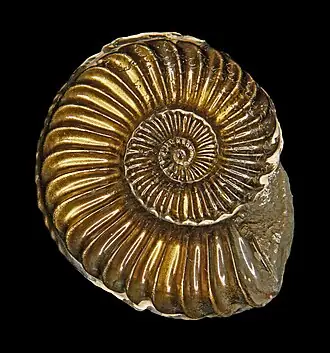
Fossil
Ammonite
The coiled shells of cephalopods that vanished with the dinosaurs. Ammolite, the iridescent Albertan variety, is one of only a handful of organic gemstones.
Mohs 3.5-4 · Brown, Iridescent
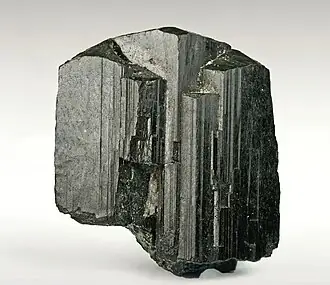
Amphibole
Arfvedsonite
A dark sodium amphibole that carries a startling blue-to-gold flash along its cleavage — sold widely and inaccurately as 'nuummite', which it superficially resembles.
Mohs 5-6 · Black, Iridescent
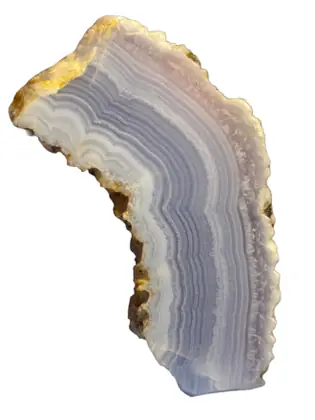
Chalcedony
Blue Lace Agate
Powder-blue banded chalcedony threaded with white lace, from a single small Namibian deposit that has been effectively mined out — which is why good material now costs multiples of what it did a decade ago.
Mohs 6.5-7 · Pale blue, Sky blue
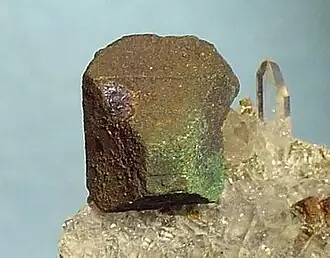
Sulfide
Bornite
Copper iron sulfide that tarnishes rapidly from bronze to deep blue and purple, giving it the same peacock nickname as chalcopyrite.
Mohs 3-3.25 · Bronze, Iridescent
Chalcedony
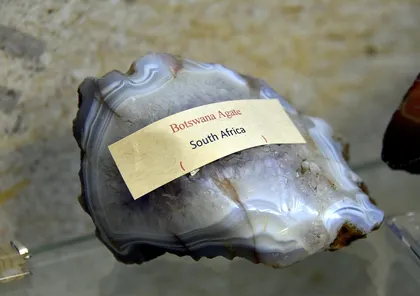
Botswana Agate
Fine grey, pink and lavender banding, often with a tiny druzy quartz eye at the centre. Softer and more muted than Mexican agates, and quietly one of the most beautiful.
Mohs 6.5-7 · Grey, Blush
Sulfide
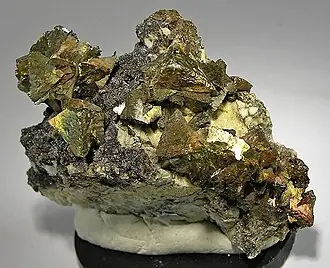
Chalcopyrite (Peacock Ore)
Copper iron sulfide whose tarnish film refracts into peacock blues, purples and greens. Most 'peacock ore' sold has been acid-treated to intensify the effect.
Mohs 3.5-4 · Gold, Iridescent
Sulfide
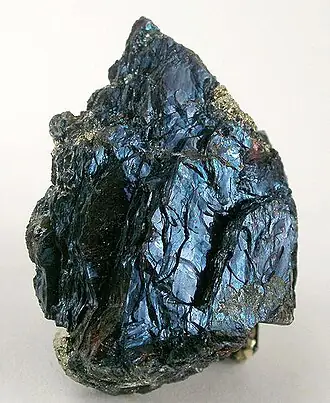
Covellite
Indigo copper sulfide with a peacock iridescence of purple, blue and bronze across its metallic plates. Butte, Montana produced crystallised specimens that have never been matched.
Mohs 1.5-2 · Deep blue, Iridescent
Chalcedony
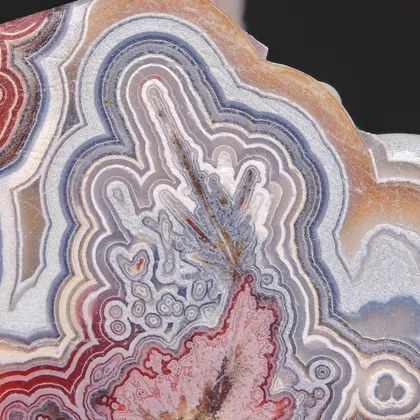
Crazy Lace Agate
Chaotic swirling agate in cream, butterscotch and brick red, formed in Cretaceous limestone in northern Mexico. Sometimes called the laughter stone for how busy and cheerful the pattern reads.
Mohs 6.5-7 · Red, Cream
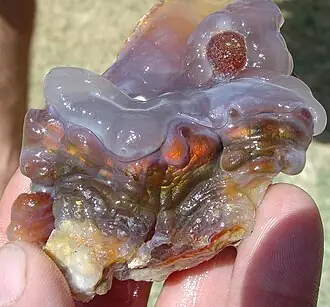
Chalcedony
Fire Agate
Chalcedony containing microscopically thin layers of iron oxide that create iridescent fire — reds, greens and golds — trapped inside the stone. Cutting it is a specialist skill: the cutter must chase the fire layer without going through it.
Mohs 6.5-7 · Brown, Red
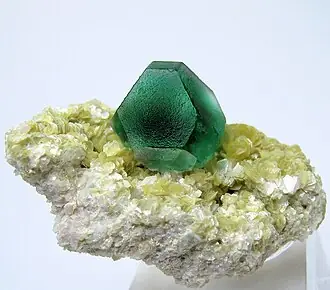
Halide
Fluorite
The most colorful mineral in the world, fluorite grows in perfect cubes and octahedra, often color-zoned in bands of green, purple and clear within a single crystal.
Mohs 4 · Green, Purple
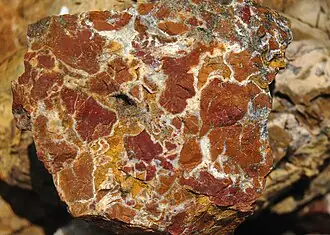
Chalcedony
Jasper
Opaque microcrystalline quartz colored by iron and clay impurities. Jasper is a family rather than a single stone, and named varieties — ocean, picture, mookaite, bumblebee — often come from a single deposit.
Mohs 6.5-7 · Red, Yellow
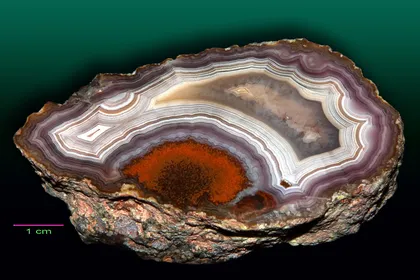
Chalcedony
Laguna Agate
Widely considered the finest banded agate on earth: tight, high-contrast red and white fortification banding from one ranch in Chihuahua. Collector-grade nodules are sold by name and by pattern.
Mohs 6.5-7 · Red, Orange
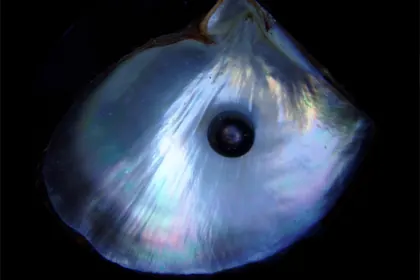
Organic
Mother of Pearl
The nacre lining of pearl oysters and freshwater mussels, cut into plates and cabochons. A soft silvery-white with a slow moving sheen rather than the hard flash of abalone.
Mohs 2.5-4 · White, Cream
Metamorphic
Nuummite
One of the oldest gem materials on earth at roughly three billion years — a black amphibole rock threaded with iridescent gold, green and violet flash from intergrown crystal lamellae. Mined by hand from a remote Greenland site with a short seasonal window.
Mohs 5.5-6 · Black, Iridescent
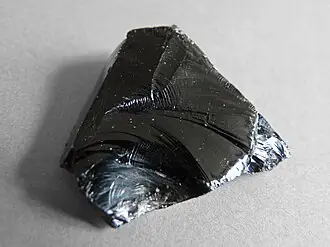
Volcanic glass
Obsidian
Not a mineral at all but volcanic glass, cooled too quickly for crystals to form. Varieties include snowflake, mahogany, sheen, rainbow and the translucent Apache tear.
Mohs 5-5.5 · Black, Mahogany
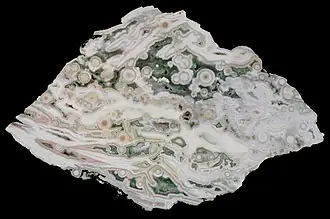
Chalcedony
Ocean Jasper
Orbicular chalcedony covered in floating spherulites like bubbles or eyes, from a tidal outcrop on the northwest coast of Madagascar reachable only at low tide. The original deposit is exhausted, so material is finite.
Mohs 6.5-7 · Green, Blush
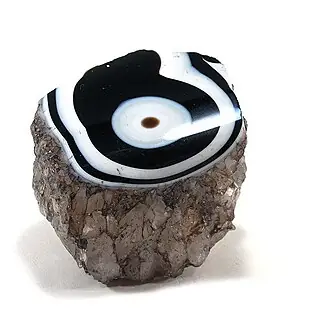
Chalcedony
Onyx
Chalcedony with straight parallel banding. Most 'black onyx' on the market is grey chalcedony dyed black, a practice so old and so standard that it is not considered a deception.
Mohs 6.5-7 · Black, White
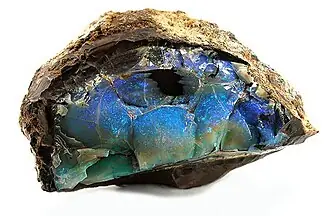
Mineraloid
Opal
Hydrated silica whose spheres diffract light into shifting play-of-color. Black opal from Lightning Ridge is the most valuable; Ethiopian Welo opal is the great recent discovery.
Mohs 5.5-6.5 · Play-of-color, White
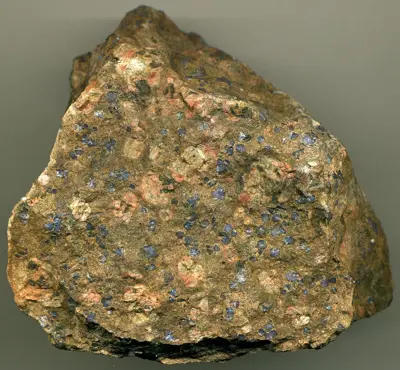
Igneous
Que Sera (Llanite)
A Brazilian rhyolitic rock in soft mottled grey, blue and rose, sold under the trade names que sera and vulcanite. Cuts into calm, cloud-like slabs and spheres.
Mohs 6-7 · Grey, Blue
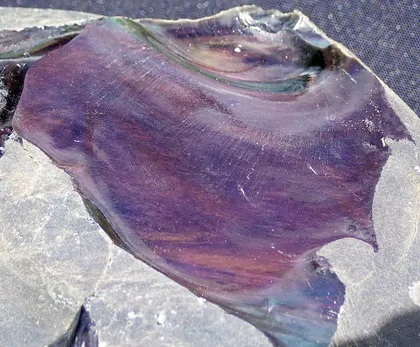
Volcanic glass
Rainbow Obsidian
Black obsidian containing aligned nanoscale magnetite crystals that throw concentric bands of green, gold and violet when the stone is oriented and polished correctly.
Mohs 5-5.5 · Black, Iridescent
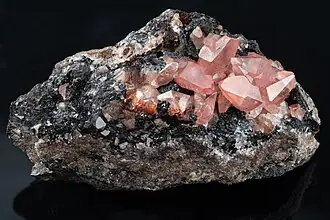
Carbonate
Rhodochrosite
Manganese carbonate in rose pink, occurring both as banded stalactitic material from Argentina and as vivid transparent rhombs from Colorado's Sweet Home Mine.
Mohs 3.5-4 · Rose pink, Red
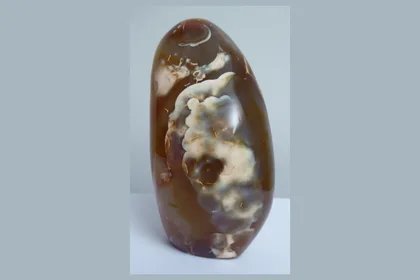
Chalcedony
Sardonyx
Straight-banded chalcedony alternating reddish-brown sard with white — the classic cameo material, because a carver can cut through the pale layer to reveal the dark one beneath.
Mohs 6.5-7 · Red, White
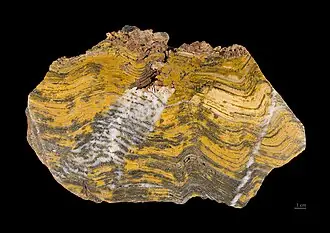
Fossil
Stromatolite
Layered structures built by cyanobacterial mats — the oldest evidence of life on earth, with examples running back 3.5 billion years. The wavy laminations polish into striking banded slabs.
Mohs 3-7 · Banded, Grey
Please noteTraditional properties, effects, and aura associations are shared for cultural, historical, and personal-interest reasons only. They are folklore, not medicine. Nothing here is medical, psychological, or financial advice, and no stone is intended to diagnose, treat, cure, or prevent any condition. Please see a qualified professional for health concerns.