Sulfide

Bornite

Copper iron sulfide that tarnishes rapidly from bronze to deep blue and purple, giving it the same peacock nickname as chalcopyrite.
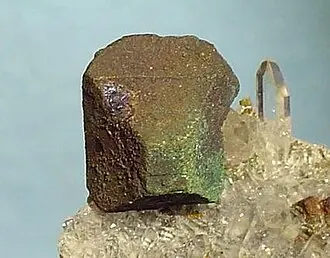
Bornite — mineral specimen
Reference photograph: Robert M. Lavinsky, CC BY-SA 3.0 · source. Specimens in the shop vary.

Judging quality

Freshly broken bornite is coppery bronze; the iridescence develops in air. Look for solid massive pieces rather than crumbly ore fragments.

Care

Soft and continually tarnishing. Store dry, handle lightly.

History & lore

Named for the Austrian mineralogist Ignaz von Born, an eighteenth-century pioneer of ore chemistry.

Cultural history, recorded as tradition rather than as medical or scientific claim.

Common questions about Bornite

What is Bornite?
Copper iron sulfide that tarnishes rapidly from bronze to deep blue and purple, giving it the same peacock nickname as chalcopyrite.
How hard is Bornite and what is it made of?
Bornite is a Sulfide-family mineral with the composition Cu5FeS4. It crystallizes in the orthorhombic system and rates 3-3.25 on the Mohs hardness scale. It occurs in bronze, iridescent.
Where does Bornite come from?
Notable localities for Bornite include USA (Montana), Mexico, Kazakhstan, Morocco.
How do you tell good Bornite from filler?
Freshly broken bornite is coppery bronze; the iridescence develops in air. Look for solid massive pieces rather than crumbly ore fragments.
How do you care for Bornite?
Soft and continually tarnishing. Store dry, handle lightly.

See it in person

Photographs only go so far

Both rooms are open six days a week, and there is always someone happy to pull pieces out of the case so you can compare them under the light.

Plan a visit
Share Bornite