The crystal encyclopedia
50 of 218
The base of the color ladder — survival, footing, physical energy.
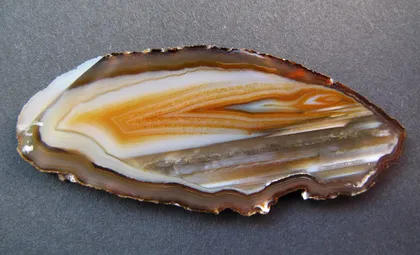
Chalcedony
Agate
Banded chalcedony, formed as silica-rich fluid seeped in layers into volcanic cavities. Every agate is a cross-section of its own slow filling, which is why no two slices repeat.
Mohs 6.5-7 · Banded, Grey
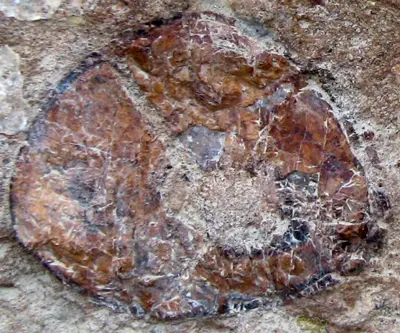
Fossil
Agatised Dinosaur Bone
Jurassic sauropod bone in which the marrow cells have been replaced cell by cell with agate and jasper — 'gembone'. The best Utah material shows red and yellow cells outlined in black, holding a mirror polish.
Mohs 6.5-7 · Red, Yellow
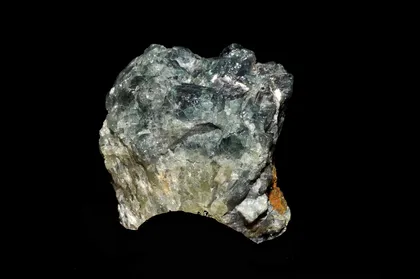
Oxide
Alexandrite
Color-change chrysoberyl: green in daylight, raspberry red under incandescent light, caused by chromium sitting in a narrow transmission window. Fine natural material above a carat is one of the most expensive colored stones on earth.
Mohs 8.5 · Emerald green, Red
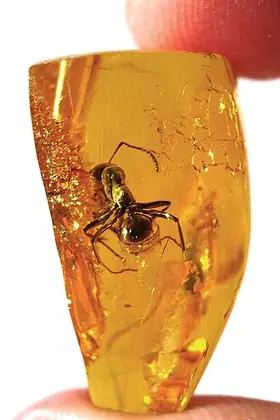
Organic
Amber
Tree resin fossilised over 30 to 100 million years. Baltic amber runs butterscotch to cognac; Dominican material can be transparent blue under daylight; Burmese burmite is the oldest at roughly 99 million years and is the amber most often carrying insect inclusions.
Mohs 2-2.5 · Amber, Honey
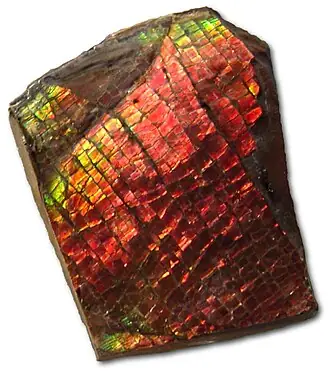
Fossil
Ammolite
The iridescent nacre of Cretaceous ammonites from a single formation in southern Alberta — one of only a handful of biogenic gemstones. Color runs from common red and green through the far rarer blue and violet, in dragon-skin, ribbon or sheet patterns.
Mohs 3.5-4.5 · Iridescent, Rainbow
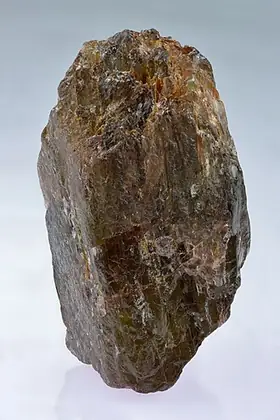
Silicate
Andalusite
A strongly pleochroic gem that shows green, gold and red-brown simultaneously from different directions — cutters deliberately orient it to display all three at once rather than trying to eliminate them.
Mohs 7-7.5 · Olive green, Brown
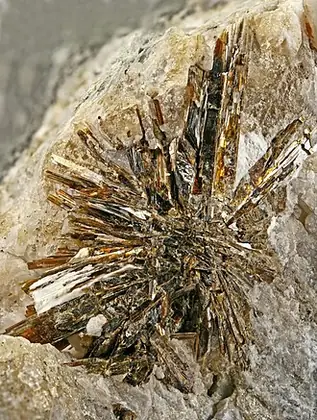
Silicate
Astrophyllite
Bronze-gold blades radiating in star-bursts through dark nepheline syenite. The name means star leaf, and a good slab looks like a night sky of gold flares.
Mohs 3-4 · Bronze, Golden
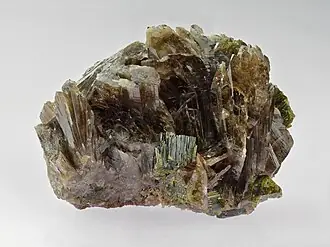
Silicate
Axinite
Sharp axe-blade crystals in clove brown with violet flashes, strongly pleochroic and unmistakable once seen.
Mohs 6.5-7 · Clove brown, Violet
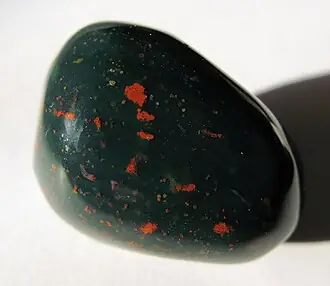
Chalcedony
Bloodstone
Dark green chalcedony flecked with red jasper. Also called heliotrope, it is one of the traditional March birthstones.
Mohs 6.5-7 · Green, Red
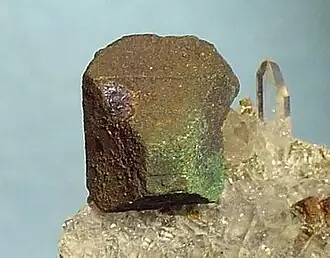
Sulfide
Bornite
Copper iron sulfide that tarnishes rapidly from bronze to deep blue and purple, giving it the same peacock nickname as chalcopyrite.
Mohs 3-3.25 · Bronze, Iridescent
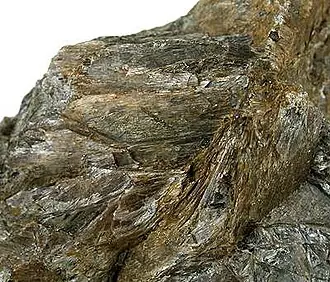
Pyroxene
Bronzite
Enstatite with enough iron to develop a warm metallic bronze sheen across the cleavage planes. Usually cut as cabochons or beads, sometimes intergrown with green serpentine.
Mohs 5-6 · Bronze, Brown
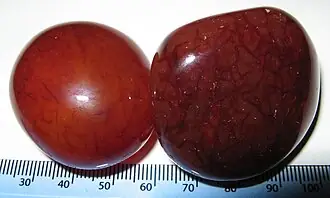
Chalcedony
Carnelian
Translucent orange to deep red chalcedony colored by iron oxide. Warm, glowing and tough, it has been one of the world's favourite carving stones for millennia.
Mohs 6.5-7 · Orange, Red
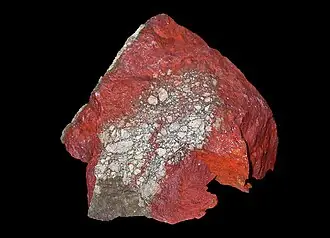
Sulfide
Cinnabar
Mercury sulfide, and the most saturated natural red in the mineral kingdom. Chinese crystals on white dolomite are the specimens collectors want; the massive ore was the world's source of mercury and of vermilion pigment.
Mohs 2-2.5 · Red, Pink-red
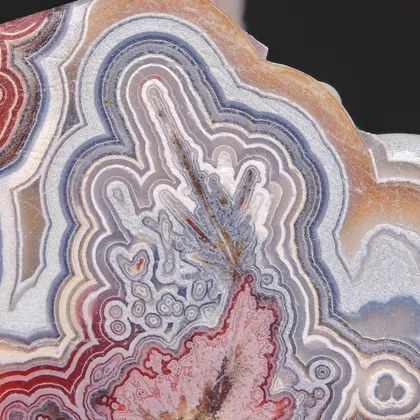
Chalcedony
Crazy Lace Agate
Chaotic swirling agate in cream, butterscotch and brick red, formed in Cretaceous limestone in northern Mexico. Sometimes called the laughter stone for how busy and cheerful the pattern reads.
Mohs 6.5-7 · Red, Cream
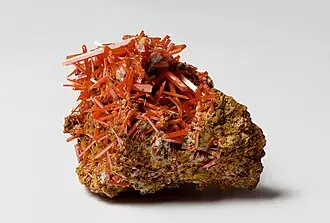
Chromate
Crocoite
Tangerine-orange lead chromate in hollow sprays of hair-fine prisms. Tasmanian Dundas material is the world standard and among the most photographed minerals in existence.
Mohs 2.5-3 · Orange, Red
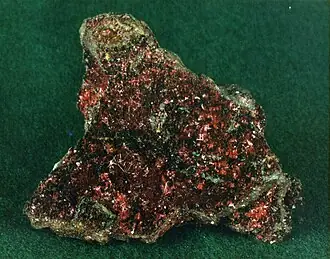
Oxide
Cuprite
Copper oxide in deep garnet-red cubes and octahedra that glow ruby when back-lit. Namibian Onganja crystals from the 1970s are legendary; the hair-like variety chalcotrichite forms scarlet velvet mats.
Mohs 3.5-4 · Red, Pink-red
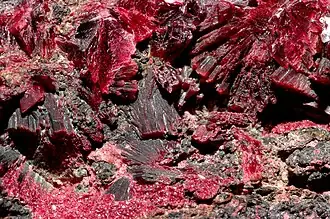
Arsenate
Erythrite
Cobalt bloom — brilliant magenta needles and crusts that form where cobalt ores weather. Moroccan Bou Azzer specimens with radiating crimson sprays are the classic.
Mohs 1.5-2.5 · Magenta, Pink-red
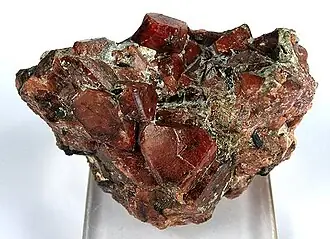
Silicate
Eudialyte
Raspberry-red zirconium silicate scattered through dark alkaline rock with black aegirine and white feldspar — a striking three-color combination unique to a handful of peralkaline intrusions.
Mohs 5-6 · Magenta, Pink-red
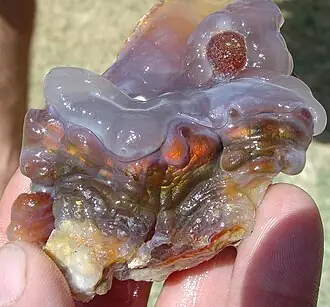
Chalcedony
Fire Agate
Chalcedony containing microscopically thin layers of iron oxide that create iridescent fire — reds, greens and golds — trapped inside the stone. Cutting it is a specialist skill: the cutter must chase the fire layer without going through it.
Mohs 6.5-7 · Brown, Red
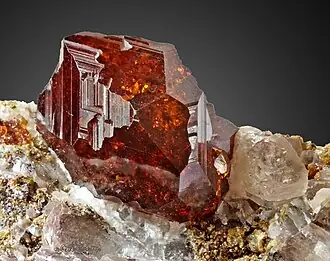
Garnet group
Garnet
A family of related silicates rather than one mineral, spanning almandine red, tsavorite green, spessartine orange and color-changing pyrope-spessartine. Crystals grow as dodecahedra with striking geometric perfection.
Mohs 6.5-7.5 · Red, Green
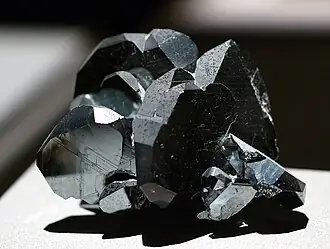
Oxide
Hematite
Iron oxide with a metallic mirror surface and a signature red-brown streak. Botryoidal 'kidney ore' from Cumbria and iridescent rainbow hematite from Brazil are the collector forms.
Mohs 5-6.5 · Silver, Black
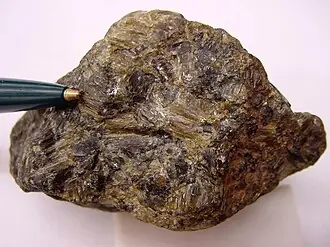
Pyroxene
Hypersthene
A dark orthopyroxene with a metallic bronze-to-silver sheen from fine exsolution lamellae. Polished Madagascan cabochons show a moving silvery streak against near-black.
Mohs 5-6 · Black, Bronze
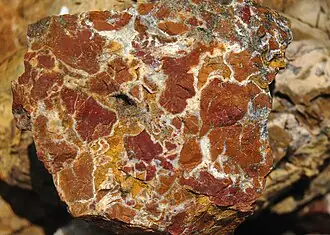
Chalcedony
Jasper
Opaque microcrystalline quartz colored by iron and clay impurities. Jasper is a family rather than a single stone, and named varieties — ocean, picture, mookaite, bumblebee — often come from a single deposit.
Mohs 6.5-7 · Red, Yellow
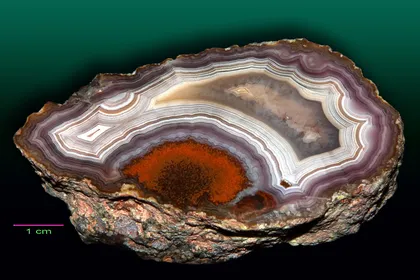
Chalcedony
Laguna Agate
Widely considered the finest banded agate on earth: tight, high-contrast red and white fortification banding from one ranch in Chihuahua. Collector-grade nodules are sold by name and by pattern.
Mohs 6.5-7 · Red, Orange
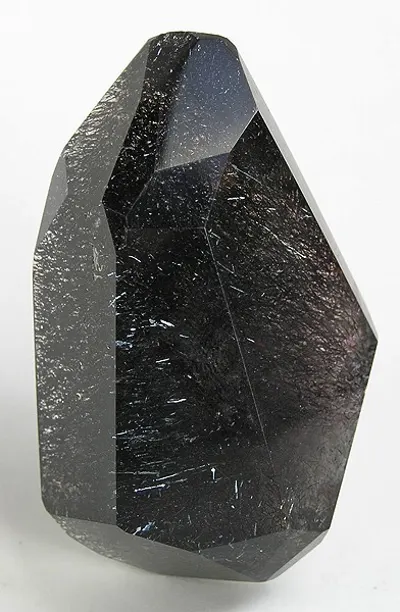
Quartz
Lepidocrocite in Quartz
Clear or amethystine quartz hosting fans of red-orange lepidocrocite blades, often in super-seven and 'harlequin' combinations from Madagascar.
Mohs 7 · Red, Orange
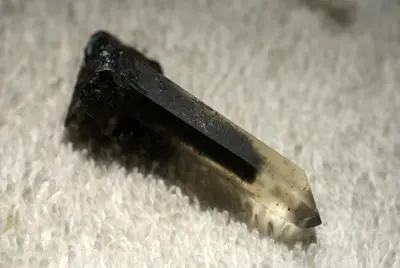
Quartz
Lodolite (Garden Quartz)
Clear quartz with mineral inclusions arranged into landscapes — mossy hills, undersea scenes, drifting clouds. Cutters orient the rough deliberately so that the interior scene reads through the polished face.
Mohs 7 · Clear, Green
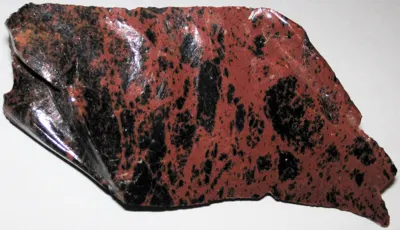
Volcanic glass
Mahogany Obsidian
Obsidian streaked with red-brown iron oxide bands, giving a marbled timber-like figure through the black glass.
Mohs 5-5.5 · Mahogany, Black
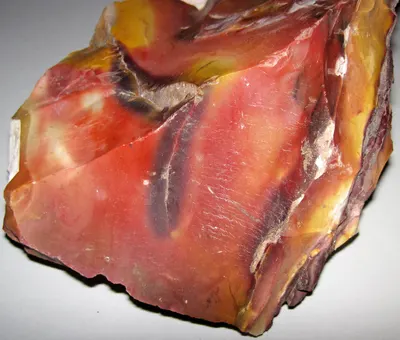
Chalcedony
Mookaite
Australian radiolarite — silicified deep-sea microfossil ooze — in mustard yellow, plum and brick red. Dense, takes a glassy polish and comes from one station in the Kennedy Ranges.
Mohs 6.5-7 · Red, Yellow
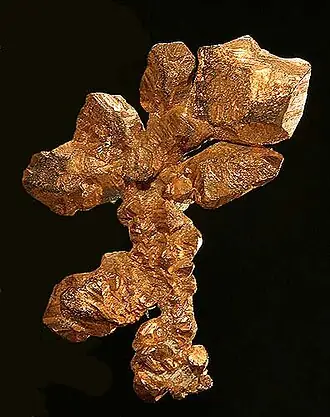
Element
Native Copper
Metallic copper that crystallised directly out of hydrothermal fluid, growing in twisted branching sprays and flattened arborescent plates. Michigan's Keweenaw deposits produced masses weighing tonnes.
Mohs 2.5-3 · Bronze, Red
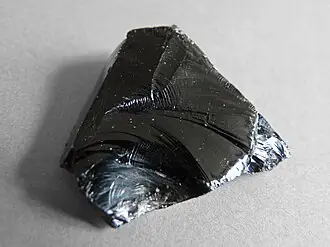
Volcanic glass
Obsidian
Not a mineral at all but volcanic glass, cooled too quickly for crystals to form. Varieties include snowflake, mahogany, sheen, rainbow and the translucent Apache tear.
Mohs 5-5.5 · Black, Mahogany
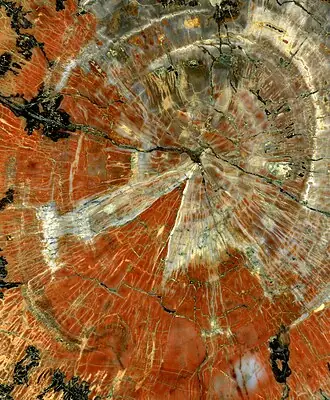
Fossil
Petrified Wood
Ancient wood in which every cell was replaced by silica, preserving growth rings, bark and even insect galleries in solid quartz.
Mohs 6.5-7 · Brown, Red
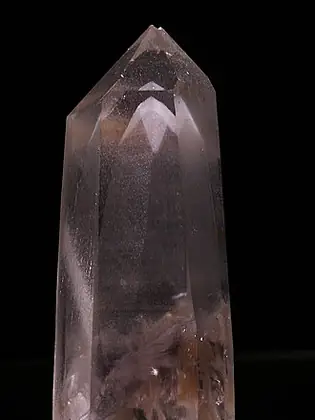
Quartz
Phantom Quartz
Quartz that paused during growth long enough for a film of chlorite, hematite or clay to settle on its faces, then resumed — leaving a ghost crystal sealed inside the finished one.
Mohs 7 · Colorless, Green
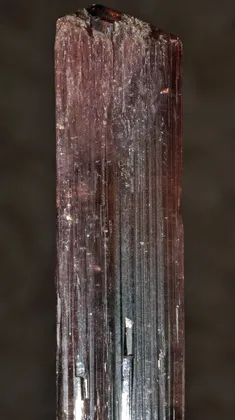
Tourmaline
Pink Tourmaline (Rubellite)
Lithium tourmaline in pink to raspberry red. Rubellite proper keeps its color under both daylight and artificial light, which is what separates it from lighter pink material.
Mohs 7-7.5 · Pink, Red
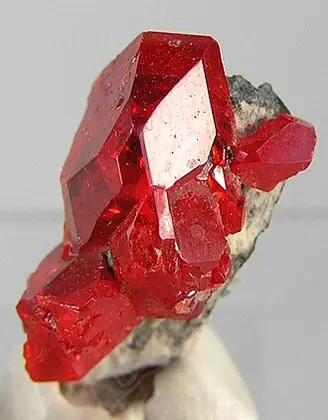
Sulfide
Realgar
Arsenic sulfide in a translucent orange-red that looks like carved candy. Chinese crystals from Shimen are the finest ever found and are stored in the dark to preserve them.
Mohs 1.5-2 · Red, Orange
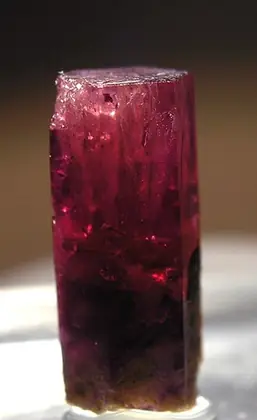
Beryl
Red Beryl
One of the rarest gem minerals in existence, found in commercial quantity at a single Utah locality. Manganese gives it a raspberry red no other beryl reaches, and faceted stones over a carat are counted in the low hundreds worldwide.
Mohs 7.5-8 · Red, Pink-red
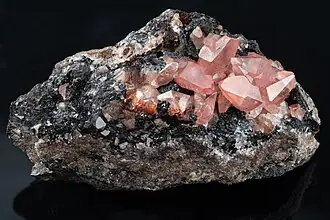
Carbonate
Rhodochrosite
Manganese carbonate in rose pink, occurring both as banded stalactitic material from Argentina and as vivid transparent rhombs from Colorado's Sweet Home Mine.
Mohs 3.5-4 · Rose pink, Red
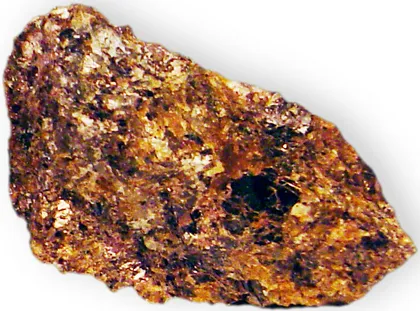
Garnet
Rhodolite Garnet
A pyrope-almandine blend with a raspberry to grape color that is lighter and more purple than common red garnet, and reads far livelier in a faceted stone.
Mohs 7-7.5 · Pink-red, Magenta
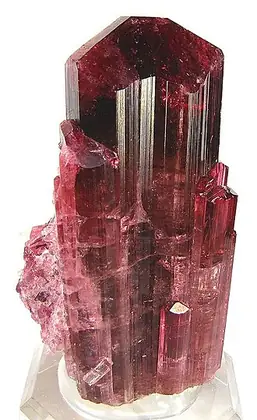
Tourmaline
Rubellite Tourmaline
The deep red to hot magenta end of elbaite tourmaline. True rubellite holds its color under both daylight and lamplight rather than going brown, which is the trade's dividing line from ordinary pink tourmaline.
Mohs 7-7.5 · Pink-red, Magenta
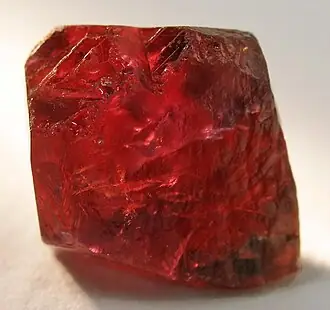
Corundum
Ruby
Red corundum, colored by chromium, and the hardest gem material after diamond. Ruby in zoisite and ruby in fuchsite are the common specimen forms; gem crystals from Mogok are the historic ideal.
Mohs 9 · Red, Pink-red
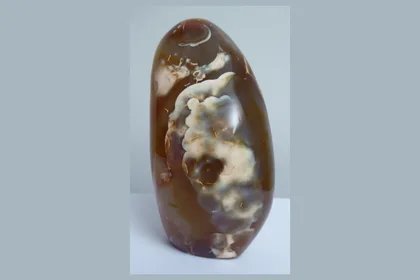
Chalcedony
Sardonyx
Straight-banded chalcedony alternating reddish-brown sard with white — the classic cameo material, because a carver can cut through the pale layer to reveal the dark one beneath.
Mohs 6.5-7 · Red, White
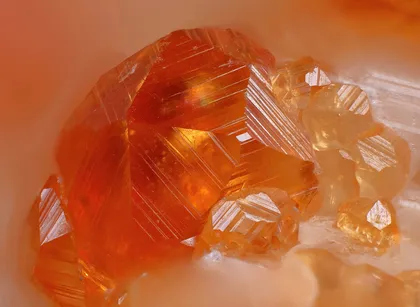
Garnet
Spessartine Garnet
Manganese garnet in a vivid mandarin orange. Namibian material from the Kunene River gave the trade name 'mandarin garnet' in the 1990s; Chinese crystals from Fujian are collectors' pieces on smoky quartz matrix.
Mohs 7-7.5 · Orange, Amber
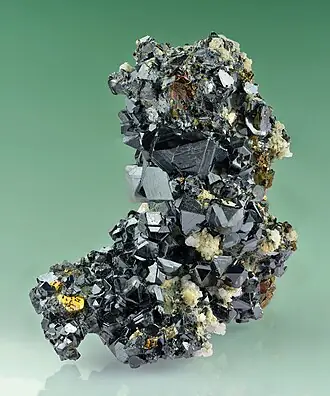
Sulfide
Sphalerite
Zinc sulfide with a dispersion three times higher than diamond, which makes cut honey-colored Spanish sphalerite one of the most fiery gemstones that exists.
Mohs 3.5-4 · Honey, Red
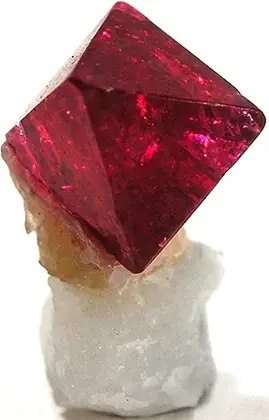
Oxide
Spinel
Long mistaken for ruby, spinel is a distinct mineral with brilliant color, excellent hardness and, crucially, almost no treatment in the trade.
Mohs 7.5-8 · Red, Pink
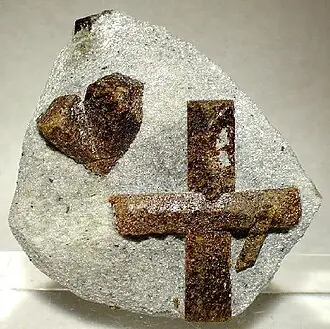
Silicate
Staurolite
Iron aluminium silicate famous for twinning into natural crosses — some at ninety degrees, some at sixty. Russian Kola material gives the crispest right-angle crosses.
Mohs 7-7.5 · Brown, Clove brown
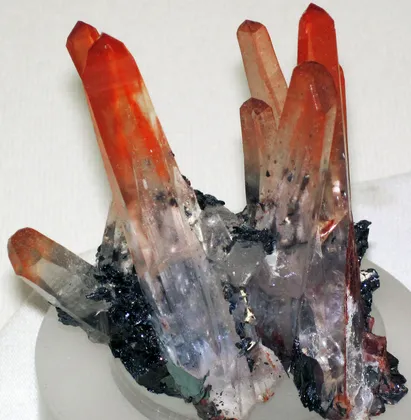
Quartz
Strawberry Quartz
Quartz filled with tiny red platelets of hematite or lepidocrocite that give a strawberry-seed sparkle through a pink body.
Mohs 7 · Pink-red, Red
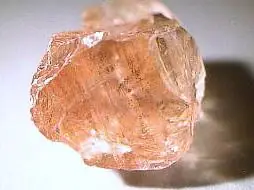
Feldspar
Sunstone
Feldspar with a glittering aventurescence from platelets of copper or hematite. Oregon sunstone is unusual in being colored by native copper, producing transparent red and green gems.
Mohs 6-6.5 · Orange, Red
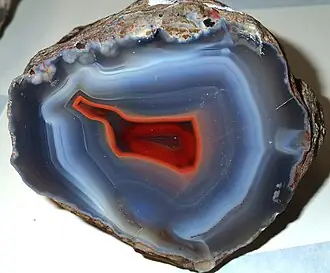
Chalcedony
Turritella Agate
Dark brown agate packed with the spiral shells of freshwater snails — properly Elimia tenera, not Turritella, but the trade name stuck a century ago. Cut faces show the spirals in cross-section like a mosaic.
Mohs 6.5-7 · Brown, Black
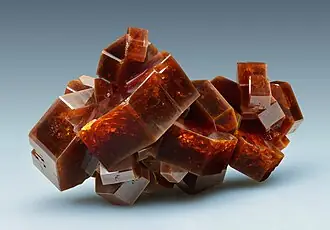
Vanadate
Vanadinite
Brilliant red-orange hexagonal crystals that grow on barite matrix in the lead deposits of Morocco. Few minerals are so intensely colored.
Mohs 3-4 · Red, Orange
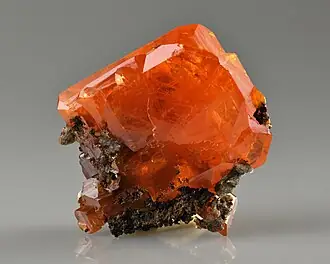
Molybdate
Wulfenite
Thin tabular crystals like stained glass windows, ranging from butterscotch yellow to the legendary deep red of Arizona's Red Cloud Mine.
Mohs 2.75-3 · Orange, Yellow
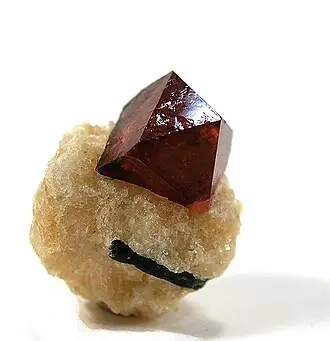
Silicate
Zircon
A genuinely brilliant natural gem with dispersion approaching diamond, and quite unrelated to cubic zirconia despite the name confusion. Cambodian material is heat-treated to the familiar electric blue; natural stones run honey, red and brown.
Mohs 6-7.5 · Blue, Golden
Please noteTraditional properties, effects, and aura associations are shared for cultural, historical, and personal-interest reasons only. They are folklore, not medicine. Nothing here is medical, psychological, or financial advice, and no stone is intended to diagnose, treat, cure, or prevent any condition. Please see a qualified professional for health concerns.