Silicate

Staurolite

Iron aluminium silicate famous for twinning into natural crosses — some at ninety degrees, some at sixty. Russian Kola material gives the crispest right-angle crosses.
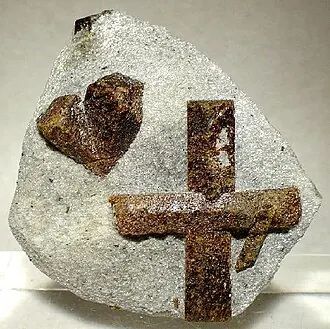
Staurolite — mineral specimen
Reference photograph: Robert M. Lavinsky, CC BY-SA 3.0 · source. Specimens in the shop vary.

Judging quality

A genuine twin has continuous crystal faces across both arms and a matte, resinous surface. Carved or glued 'fairy crosses' show tool marks and a seam.

Care

Hard but often weathered. Dry brush is enough.

History & lore

Appalachian folklore calls them fairy stones; Virginia protects one deposit as a state park where visitors may still hunt them.

Cultural history, recorded as tradition rather than as medical or scientific claim.

Common questions about Staurolite

What is Staurolite?
Iron aluminium silicate famous for twinning into natural crosses — some at ninety degrees, some at sixty. Russian Kola material gives the crispest right-angle crosses.
How hard is Staurolite and what is it made of?
Staurolite is a Silicate-family mineral with the composition Fe2Al9Si4O23(OH). It crystallizes in the monoclinic system and rates 7-7.5 on the Mohs hardness scale. It occurs in brown, clove brown, black.
Where does Staurolite come from?
Notable localities for Staurolite include Virginia, USA, Georgia, USA, Russia (Kola), Brittany, France.
How do you tell good Staurolite from filler?
A genuine twin has continuous crystal faces across both arms and a matte, resinous surface. Carved or glued 'fairy crosses' show tool marks and a seam.
How do you care for Staurolite?
Hard but often weathered. Dry brush is enough.

See it in person

Photographs only go so far

Both rooms are open six days a week, and there is always someone happy to pull pieces out of the case so you can compare them under the light.

Plan a visit
Share Staurolite