Judging quality
For specimens, look for complete undamaged dodecahedral faces in matrix. For color, garnets are rarely treated, which makes untreated saturation a genuine value.
Garnet group
A family of related silicates rather than one mineral, spanning almandine red, tsavorite green, spessartine orange and color-changing pyrope-spessartine. Crystals grow as dodecahedra with striking geometric perfection.
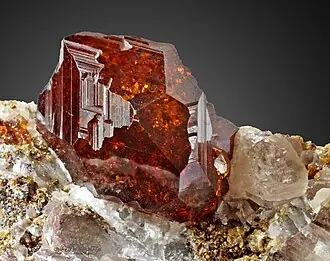
For specimens, look for complete undamaged dodecahedral faces in matrix. For color, garnets are rarely treated, which makes untreated saturation a genuine value.
Durable and easy to care for. Warm soapy water.
Bohemian pyrope garnets dominated European jewellery in the nineteenth century, mined and cut around Trebnice for hundreds of years.
Cultural history, recorded as tradition rather than as medical or scientific claim.
See it in person
Both rooms are open six days a week, and there is always someone happy to pull pieces out of the case so you can compare them under the light.