Judging quality
Look for glowing red rather than brownish or purplish tones. Nearly all commercial ruby is heat-treated; lead-glass-filled ruby is much lower value and must be disclosed.
Corundum
Red corundum, colored by chromium, and the hardest gem material after diamond. Ruby in zoisite and ruby in fuchsite are the common specimen forms; gem crystals from Mogok are the historic ideal.
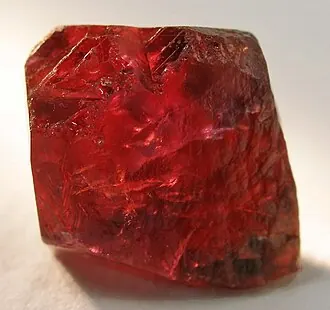
Look for glowing red rather than brownish or purplish tones. Nearly all commercial ruby is heat-treated; lead-glass-filled ruby is much lower value and must be disclosed.
Extremely hard and safe to clean, though glass-filled stones must avoid heat and acid.
The Mogok Stone Tract in Burma has produced ruby continuously for over five centuries, its finest color known as 'pigeon's blood'.
Cultural history, recorded as tradition rather than as medical or scientific claim.
See it in person
Both rooms are open six days a week, and there is always someone happy to pull pieces out of the case so you can compare them under the light.