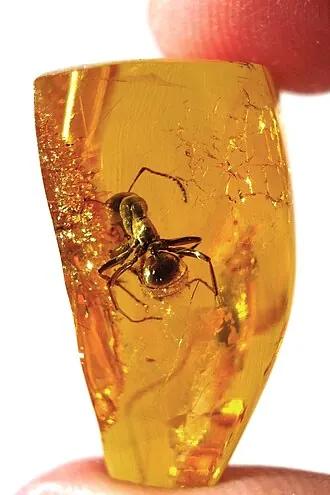
- What is Amber?
- Tree resin fossilised over 30 to 100 million years. Baltic amber runs butterscotch to cognac; Dominican material can be transparent blue under daylight; Burmese burmite is the oldest at roughly 99 million years and is the amber most often carrying insect inclusions.
- How hard is Amber and what is it made of?
- Amber is a Organic-family mineral with the composition C10H16O (fossil resin). It crystallizes in the amorphous system and rates 2-2.5 on the Mohs hardness scale. It occurs in amber, honey, golden, clove brown.
- Where does Amber come from?
- Notable localities for Amber include Baltic coast (Kaliningrad, Poland, Lithuania), Chiapas, Mexico, Dominican Republic, Myanmar.
- How do you tell good Amber from filler?
- Amber floats in saturated salt water, warms instantly in the hand, and smells faintly of pine when rubbed hard. Beware pressed amber (swirled 'sun spangles' throughout), copal (young resin, tacky under solvent) and plastic (heavy, no static charge).
- How do you care for Amber?
- Very soft and flammable. Keep away from perfume, alcohol and hot light. Clean with a damp cloth only.