Silicate

Astrophyllite

Bronze-gold blades radiating in star-bursts through dark nepheline syenite. The name means star leaf, and a good slab looks like a night sky of gold flares.
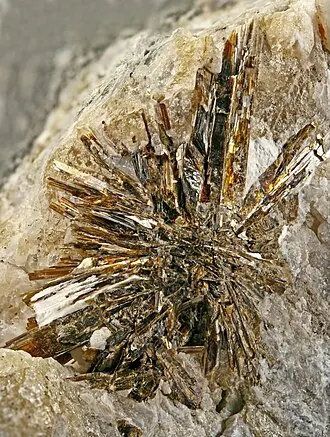
Astrophyllite — mineral specimen
Reference photograph: Modris Baum, Public domain · source. Specimens in the shop vary.

Judging quality

The blades have a bright metallic-bronze schiller and lie in flat radiating sprays. Golden mica in matrix looks similar but lacks the star arrangement.

Care

Soft with perfect cleavage; the blades flake. Handle gently and avoid ultrasonics.

History & lore

First described from the Norwegian island of Låven in 1854; the Kola material of the twentieth century made it a collector staple.

Cultural history, recorded as tradition rather than as medical or scientific claim.

Common questions about Astrophyllite

What is Astrophyllite?
Bronze-gold blades radiating in star-bursts through dark nepheline syenite. The name means star leaf, and a good slab looks like a night sky of gold flares.
How hard is Astrophyllite and what is it made of?
Astrophyllite is a Silicate-family mineral with the composition K2NaFe7Ti2Si8O26(OH)4F. It crystallizes in the triclinic system and rates 3-4 on the Mohs hardness scale. It occurs in bronze, golden, black.
Where does Astrophyllite come from?
Notable localities for Astrophyllite include Kola Peninsula, Russia, Greenland, Norway (Låven), Colorado, USA.
How do you tell good Astrophyllite from filler?
The blades have a bright metallic-bronze schiller and lie in flat radiating sprays. Golden mica in matrix looks similar but lacks the star arrangement.
How do you care for Astrophyllite?
Soft with perfect cleavage; the blades flake. Handle gently and avoid ultrasonics.

See it in person

Photographs only go so far

Both rooms are open six days a week, and there is always someone happy to pull pieces out of the case so you can compare them under the light.

Plan a visit
Share Astrophyllite