Mica

Muscovite

The common white mica, splitting into flexible transparent sheets. Star muscovite and pink Brazilian rosettes are the specimen forms.
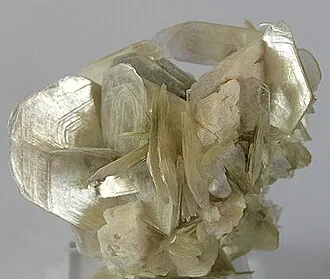
Muscovite — mineral specimen
Reference photograph: Robert M. Lavinsky, CC BY-SA 3.0 · source. Specimens in the shop vary.

Judging quality

Look for large undamaged books with mirror-bright cleavage surfaces, or complete rosettes on matrix. Edges damage easily during extraction.

Care

Extremely soft and flexible. Never soak; dust with a dry brush.

History & lore

Called muscovite because large sheets from Russia were used as window glass — 'Muscovy glass' — before flat glass was common.

Cultural history, recorded as tradition rather than as medical or scientific claim.

Common questions about Muscovite

What is Muscovite?
The common white mica, splitting into flexible transparent sheets. Star muscovite and pink Brazilian rosettes are the specimen forms.
How hard is Muscovite and what is it made of?
Muscovite is a Mica-family mineral with the composition KAl2(AlSi3O10)(OH)2. It crystallizes in the monoclinic system and rates 2-2.5 on the Mohs hardness scale. It occurs in silver, pink, green.
Where does Muscovite come from?
Notable localities for Muscovite include Brazil, India, USA (Connecticut), Pakistan.
How do you tell good Muscovite from filler?
Look for large undamaged books with mirror-bright cleavage surfaces, or complete rosettes on matrix. Edges damage easily during extraction.
How do you care for Muscovite?
Extremely soft and flexible. Never soak; dust with a dry brush.

See it in person

Photographs only go so far

Both rooms are open six days a week, and there is always someone happy to pull pieces out of the case so you can compare them under the light.

Plan a visit
Share Muscovite