The crystal encyclopedia
42 of 218
Violet, indigo and iridescent material kept for inner work and dreaming.
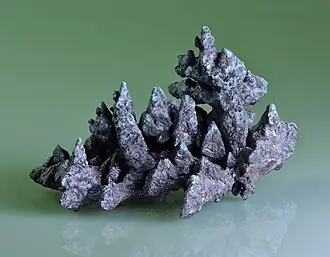
Sulfide
Acanthite
Silver sulfide, the principal ore of silver, in sooty black crystals with a metallic sheen. Mexican specimens often intergrow with native silver wires.
Mohs 2-2.5 · Black, Lead grey
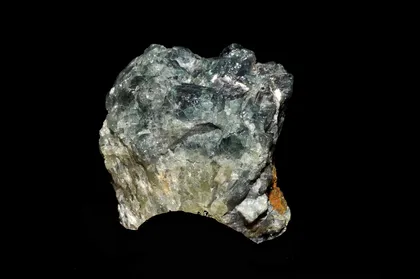
Oxide
Alexandrite
Color-change chrysoberyl: green in daylight, raspberry red under incandescent light, caused by chromium sitting in a narrow transmission window. Fine natural material above a carat is one of the most expensive colored stones on earth.
Mohs 8.5 · Emerald green, Red
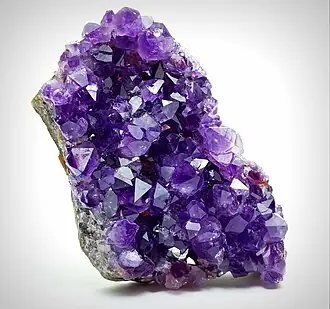
Quartz
Amethyst
Purple quartz, colored by trace iron and natural irradiation. Amethyst forms the great cathedral geodes of Brazil and Uruguay, the deep royal 'Zambian' crystals of Africa, and the delicate pale wands of Vera Cruz. The largest pieces in our collection are geodes taller than a person.
Mohs 7 · Purple, Violet
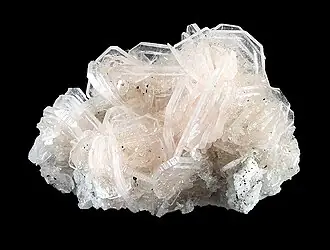
Phyllosilicate
Apophyllite
Glassy pyramidal crystals that grow in the basalt cavities of the Deccan Traps, frequently perched on green stilbite or purple chalcedony.
Mohs 4.5-5 · Colorless, Green
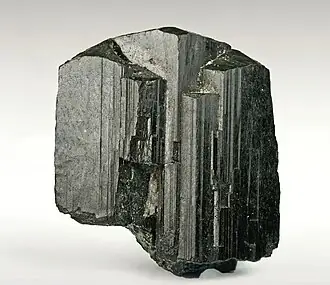
Amphibole
Arfvedsonite
A dark sodium amphibole that carries a startling blue-to-gold flash along its cleavage — sold widely and inaccurately as 'nuummite', which it superficially resembles.
Mohs 5-6 · Black, Iridescent
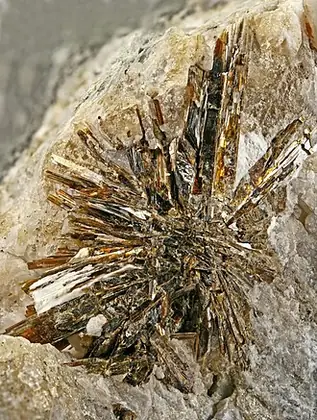
Silicate
Astrophyllite
Bronze-gold blades radiating in star-bursts through dark nepheline syenite. The name means star leaf, and a good slab looks like a night sky of gold flares.
Mohs 3-4 · Bronze, Golden
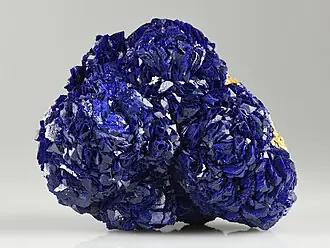
Carbonate
Azurite
Intense blue copper carbonate, frequently intergrown with green malachite into which it slowly alters over geological time.
Mohs 3.5-4 · Deep blue
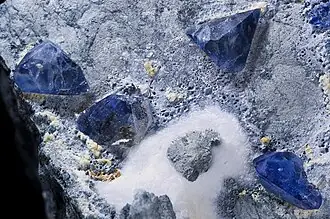
Silicate
Benitoite
California's state gemstone and a genuine local rarity: sapphire-blue triangular crystals in white natrolite, from one small serpentinite body in San Benito County. The mine is effectively worked out, which makes every good specimen finite.
Mohs 6-6.5 · Blue, Deep blue
Silicate
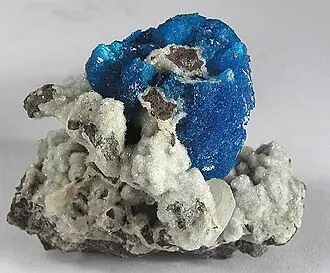
Cavansite
Vivid blue rosettes of calcium vanadium silicate that grow in the basalt quarries near Pune, almost always perched on white stilbite or heulandite.
Mohs 3-4 · Electric blue
Silicate
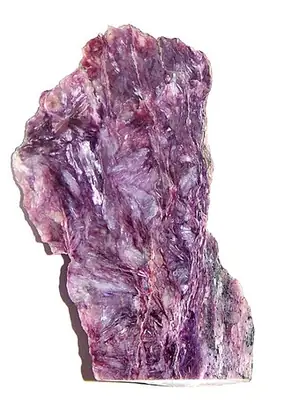
Charoite
Swirling fibrous violet silicate found only along the Chara River in Siberia. The chatoyant feathered patterning is unmistakable.
Mohs 5-6 · Violet, Purple
Quartz
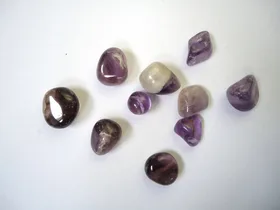
Chevron Amethyst
Banded amethyst in which purple and milky white quartz alternate in sharp V-shaped chevrons, recording rhythmic growth along the vein.
Mohs 7 · Purple, White
Meteorite
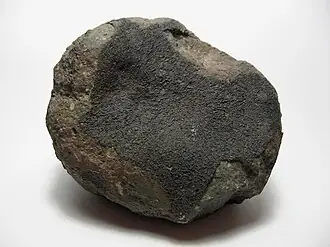
Chondrite Meteorite
The most common meteorite type and the oldest rock anyone can hold: stony material containing chondrules, millimetre droplets of melt that condensed 4.56 billion years ago before the planets existed.
Mohs 5-6 · Grey, Brown
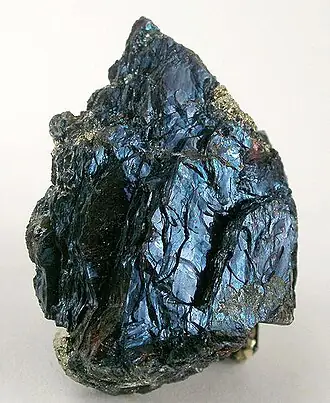
Sulfide
Covellite
Indigo copper sulfide with a peacock iridescence of purple, blue and bronze across its metallic plates. Butte, Montana produced crystallised specimens that have never been matched.
Mohs 1.5-2 · Deep blue, Iridescent
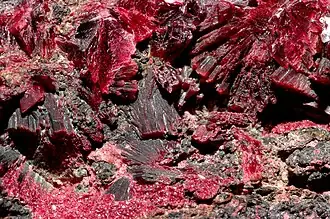
Arsenate
Erythrite
Cobalt bloom — brilliant magenta needles and crusts that form where cobalt ores weather. Moroccan Bou Azzer specimens with radiating crimson sprays are the classic.
Mohs 1.5-2.5 · Magenta, Pink-red
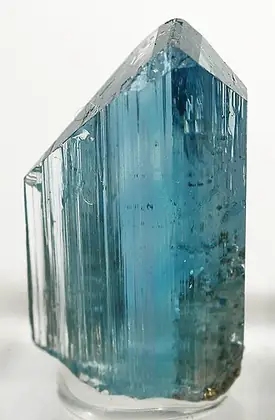
Silicate
Euclase
A collector's gem in soft aquamarine blue, notoriously difficult to cut because of perfect cleavage — the name means 'easily broken'. Colombian crystals from the emerald belt are the finest blue known.
Mohs 7.5 · Pale blue, Blue
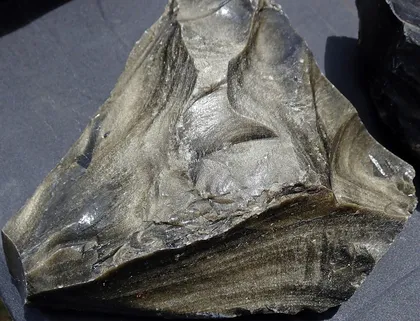
Volcanic glass
Gold & Silver Sheen Obsidian
Obsidian with a metallic golden or silver shimmer produced by a layer of aligned microscopic gas bubbles reflecting light in unison.
Mohs 5-5.5 · Black, Golden
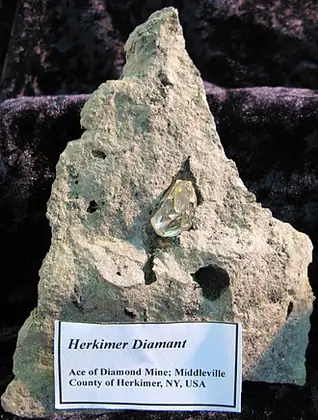
Quartz
Herkimer Diamond
Doubly terminated quartz crystals that grew free-floating in pockets of Cambrian dolostone, emerging with natural points at both ends and extraordinary clarity.
Mohs 7 · Colorless
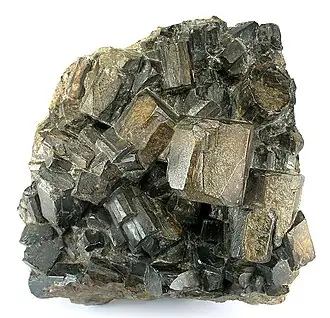
Cordierite
Iolite
Strongly pleochroic cordierite that reads violet-blue from one direction and pale yellow-grey from another, all within a single crystal.
Mohs 7-7.5 · Violet-blue, Grey
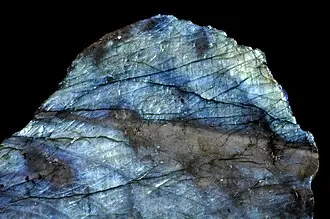
Feldspar
Labradorite
A plagioclase feldspar that hides fire inside dull grey stone. Light striking internal lamellae scatters into blue, gold, green and, in the best pieces, full-spectrum flash.
Mohs 6-6.5 · Grey, Blue
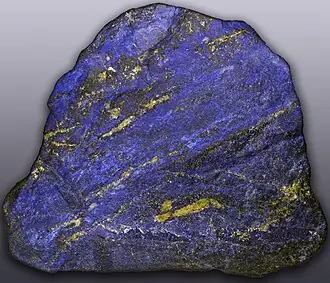
Rock (lazurite)
Lapis Lazuli
A rock rather than a single mineral: deep blue lazurite with white calcite and flecks of golden pyrite. The Sar-e-Sang mines of Badakhshan have supplied the world for over six thousand years.
Mohs 5-5.5 · Blue, Gold
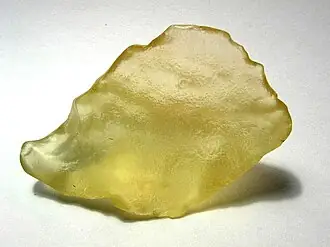
Impactite
Libyan Desert Glass
Almost pure silica glass, twenty-nine million years old, scattered across a remote corner of the Sahara by an impact event that has never been fully resolved.
Mohs 6-7 · Pale yellow, Clear
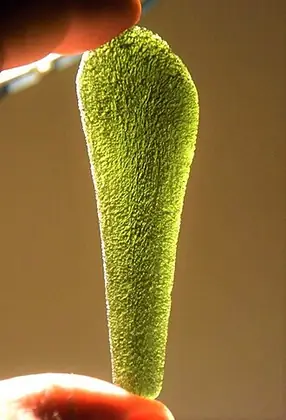
Tektite
Moldavite
A tektite: natural glass formed roughly fifteen million years ago when a meteorite struck what is now southern Germany and splashed molten crust across Bohemia.
Mohs 5.5-7 · Bottle green
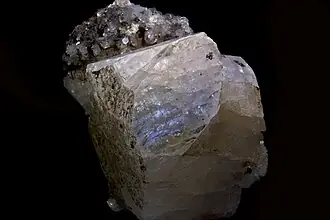
Feldspar
Moonstone
Orthoclase feldspar with a floating blue-white sheen called adularescence, caused by light scattering between microscopic layers of two feldspars.
Mohs 6-6.5 · White, Peach
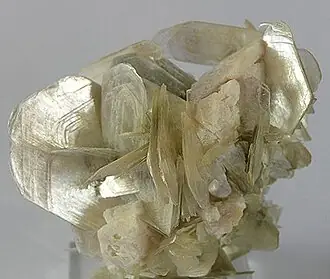
Mica
Muscovite
The common white mica, splitting into flexible transparent sheets. Star muscovite and pink Brazilian rosettes are the specimen forms.
Mohs 2-2.5 · Silver, Pink
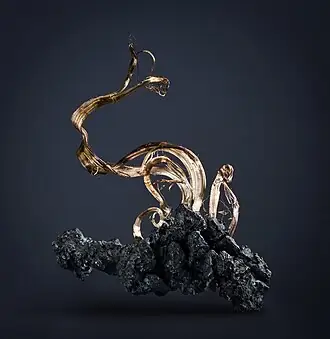
Element
Native Silver
Silver in wires, ropes and herringbone crystal groups. Kongsberg produced the finest wire silver ever mined, and specimens from its 340-year run are museum currency.
Mohs 2.5-3 · Silver, Grey
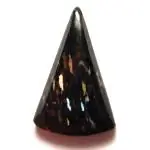
Metamorphic
Nuummite
One of the oldest gem materials on earth at roughly three billion years — a black amphibole rock threaded with iridescent gold, green and violet flash from intergrown crystal lamellae. Mined by hand from a remote Greenland site with a short seasonal window.
Mohs 5.5-6 · Black, Iridescent
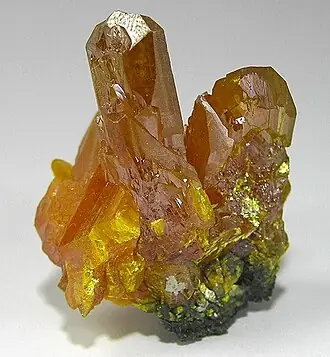
Sulfide
Orpiment
Arsenic trisulfide in sheaves of golden foliated blades with a resinous to pearly flash. It usually grows alongside realgar, the pair making one of the most striking red-and-gold associations in mineralogy.
Mohs 1.5-2 · Golden, Yellow
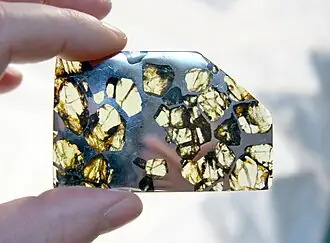
Meteorite
Pallasite Meteorite
The rarest class of meteorite most people ever see: olivine crystals suspended in a nickel-iron matrix, formed at the boundary between the core and mantle of a shattered planetesimal. Cut into slices, the gem olivine glows amber-green in transmitted light.
Mohs 4-6.5 · Silver, Golden
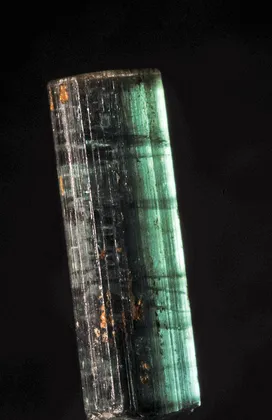
Tourmaline
Paraíba Tourmaline
Copper-bearing tourmaline with a neon blue-green glow unlike any other gem. Brazilian material from the original 1980s Paraíba workings commands a substantial premium over the chemically identical African stones.
Mohs 7-7.5 · Cyan, Turquoise
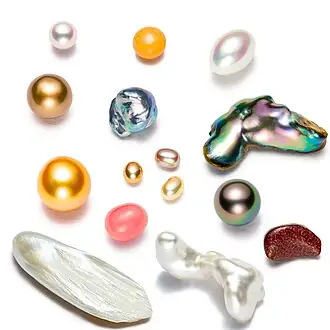
Organic
Pearl
Concentric nacre laid down by a mollusc around an irritant. Almost all pearls on the market are cultured; natural pearls are rare enough to be an auction category of their own.
Mohs 2.5-4 · White, Cream
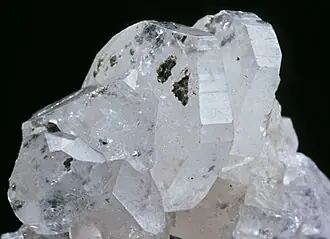
Silicate
Phenakite
A hard, brilliant beryllium silicate that is rare as gem rough and prized by collectors for water-clear rhombohedral crystals. Its name comes from the Greek for deceiver, because it was so often mistaken for quartz.
Mohs 7.5-8 · Colorless, White
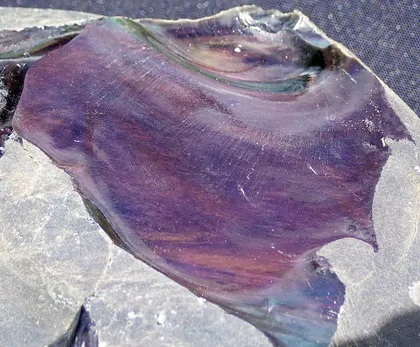
Volcanic glass
Rainbow Obsidian
Black obsidian containing aligned nanoscale magnetite crystals that throw concentric bands of green, gold and violet when the stone is oriented and polished correctly.
Mohs 5-5.5 · Black, Iridescent
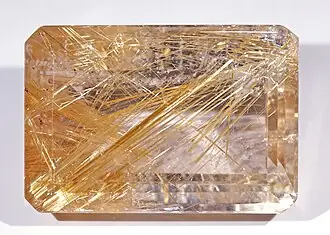
Quartz
Rutilated Quartz
Clear or smoky quartz threaded with needles of rutile, a titanium oxide that grows in golden, copper or silver hairs. The best material looks like light frozen mid-flight.
Mohs 7 · Colorless, Golden
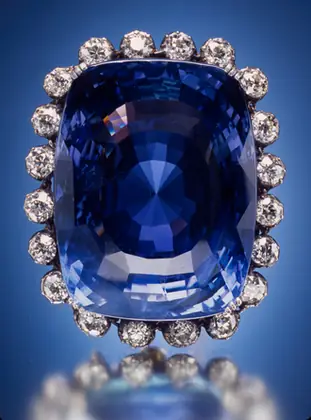
Corundum
Sapphire
Every color of gem corundum other than red. Blue comes from iron and titanium; the pink-orange padparadscha is the rarest and most coveted.
Mohs 9 · Blue, Yellow
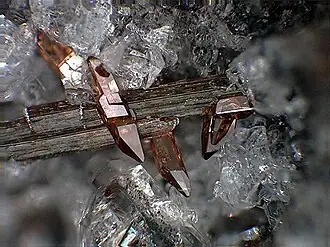
Silicate
Sphene (Titanite)
Titanite, better known as sphene, has dispersion higher than diamond, throwing intense rainbow fire from every cut surface.
Mohs 5-5.5 · Green, Yellow
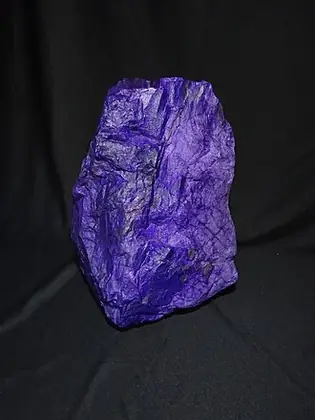
Cyclosilicate
Sugilite
Deep violet manganese silicate, effectively a single-deposit stone: virtually all gem sugilite comes from the Wessels Mine in the Kalahari manganese field.
Mohs 5.5-6.5 · Violet, Magenta
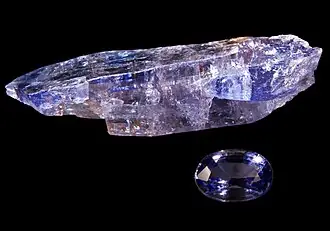
Zoisite
Tanzanite
Blue-violet zoisite found in a single four-square-mile stretch of northern Tanzania. Almost all material is heat-treated to convert brownish rough into blue.
Mohs 6-7 · Violet, Blue
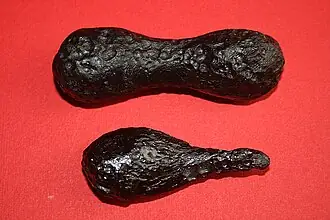
Impactite
Tektite
Terrestrial rock melted and flung into the atmosphere by a large impact, then frozen into glass as it fell. Indochinite tektites carry deep sculpted grooves; australites can retain aerodynamic flanges from atmospheric re-entry.
Mohs 5-6 · Black, Brown
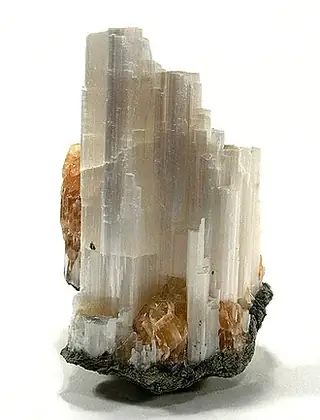
Borate
Ulexite
'TV rock' — parallel fibres act as natural optical fibres and project an image from the base of a cut slab to its polished top, so text under the stone appears to float on its surface.
Mohs 2-2.5 · White, Colorless
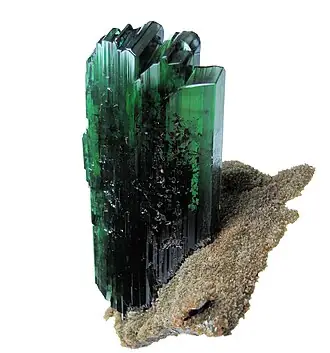
Phosphate
Vivianite
Bladed iron phosphate that grows colorless and darkens through blue-green to near-black as it oxidises in light. Bolivian crystals reach hand size and are among the most dramatic bladed specimens available.
Mohs 1.5-2 · Blue-green, Deep blue
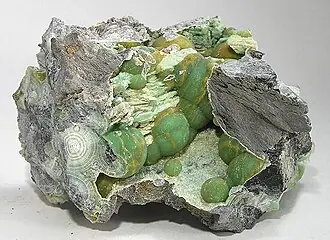
Phosphate
Wavellite
Radiating spheres of green needles that, when broken open, show a starburst cross-section like a cut kiwi. Arkansas material from the Ouachita Mountains is the world's best.
Mohs 3.5-4 · Apple green, Yellow-green
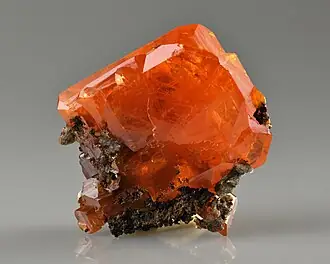
Molybdate
Wulfenite
Thin tabular crystals like stained glass windows, ranging from butterscotch yellow to the legendary deep red of Arizona's Red Cloud Mine.
Mohs 2.75-3 · Orange, Yellow
Please noteTraditional properties, effects, and aura associations are shared for cultural, historical, and personal-interest reasons only. They are folklore, not medicine. Nothing here is medical, psychological, or financial advice, and no stone is intended to diagnose, treat, cure, or prevent any condition. Please see a qualified professional for health concerns.