Phosphate

Vivianite

Bladed iron phosphate that grows colorless and darkens through blue-green to near-black as it oxidises in light. Bolivian crystals reach hand size and are among the most dramatic bladed specimens available.
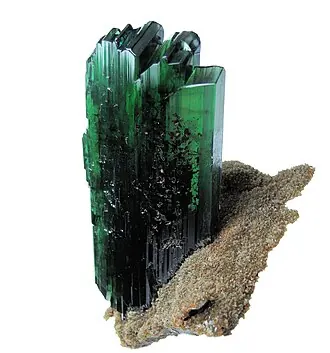
Vivianite — mineral specimen
Reference photograph: CarlesMillan, CC BY-SA 4.0 · source. Specimens in the shop vary.

Judging quality

Soft, flexible cleavage laminae and pronounced pleochroism — turning a blade shifts it from deep blue to pale olive.

Care

Extremely light-sensitive and soft. Keep boxed in the dark; every hour on a sunlit shelf costs color permanently.

History & lore

Vivianite forms in bogs and burials, and archaeologists routinely find blue crusts on bones and iron artefacts from waterlogged sites.

Cultural history, recorded as tradition rather than as medical or scientific claim.

Common questions about Vivianite

What is Vivianite?
Bladed iron phosphate that grows colorless and darkens through blue-green to near-black as it oxidises in light. Bolivian crystals reach hand size and are among the most dramatic bladed specimens available.
How hard is Vivianite and what is it made of?
Vivianite is a Phosphate-family mineral with the composition Fe3(PO4)2·8H2O. It crystallizes in the monoclinic system and rates 1.5-2 on the Mohs hardness scale. It occurs in blue-green, deep blue, black-green.
Where does Vivianite come from?
Notable localities for Vivianite include Bolivia (Huanuni), Cameroon, Brazil, Kerch, Ukraine.
How do you tell good Vivianite from filler?
Soft, flexible cleavage laminae and pronounced pleochroism — turning a blade shifts it from deep blue to pale olive.
How do you care for Vivianite?
Extremely light-sensitive and soft. Keep boxed in the dark; every hour on a sunlit shelf costs color permanently.

See it in person

Photographs only go so far

Both rooms are open six days a week, and there is always someone happy to pull pieces out of the case so you can compare them under the light.

Plan a visit
Share Vivianite