Judging quality
Look for deep sapphire-blue color zoning, glassy bladed faces and intact tips. Kyanite splits easily along its length, so undamaged blades command a premium.
Silicate
A remarkable mineral with two different hardnesses in one crystal: about 4.5 along the blade and 7 across it. Blue blades from Brazil and Nepal are the classic specimen.
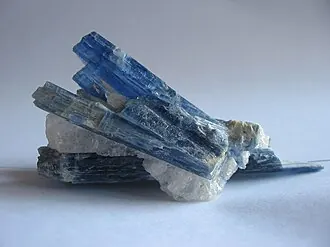
Look for deep sapphire-blue color zoning, glassy bladed faces and intact tips. Kyanite splits easily along its length, so undamaged blades command a premium.
Splinters along its length. Handle by the flat faces; rinse and dry.
Its directional hardness made it a standard classroom demonstration of anisotropy for over a century.
Cultural history, recorded as tradition rather than as medical or scientific claim.
See it in person
Both rooms are open six days a week, and there is always someone happy to pull pieces out of the case so you can compare them under the light.