Judging quality
The classic specimen is a complete blue ball or rosette sitting cleanly on contrasting white zeolite. Color should be electric, not dull grey-blue, and the rosette intact.
Silicate
Vivid blue rosettes of calcium vanadium silicate that grow in the basalt quarries near Pune, almost always perched on white stilbite or heulandite.
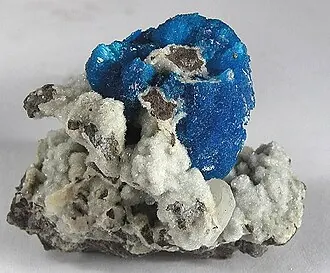
The classic specimen is a complete blue ball or rosette sitting cleanly on contrasting white zeolite. Color should be electric, not dull grey-blue, and the rosette intact.
Extremely fragile and light-sensitive. Never wash; display out of direct sunlight.
Cavansite was first described in 1967 from Oregon, but the Indian quarries produce nearly all specimen material.
Cultural history, recorded as tradition rather than as medical or scientific claim.
See it in person
Both rooms are open six days a week, and there is always someone happy to pull pieces out of the case so you can compare them under the light.