Judging quality
Look for deep blue with violet flash rather than pale washed tones. Trichroism means color varies with orientation; heat treatment is universal and expected.
Zoisite
Blue-violet zoisite found in a single four-square-mile stretch of northern Tanzania. Almost all material is heat-treated to convert brownish rough into blue.
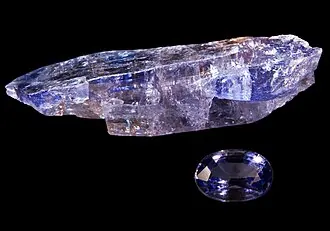
Look for deep blue with violet flash rather than pale washed tones. Trichroism means color varies with orientation; heat treatment is universal and expected.
Relatively soft with one cleavage direction and sensitive to sudden temperature change. Never ultrasonic.
Discovered in 1967 and named by Tiffany & Co., which judged 'blue zoisite' unmarketable.
Cultural history, recorded as tradition rather than as medical or scientific claim.
See it in person
Both rooms are open six days a week, and there is always someone happy to pull pieces out of the case so you can compare them under the light.