Pyroxene

Aegirine

Long, sharply striated black-green prisms, most famously from Mount Malosa in Malawi, where they grow with orange zircon and smoky quartz in some of the most photogenic combination specimens of recent decades.
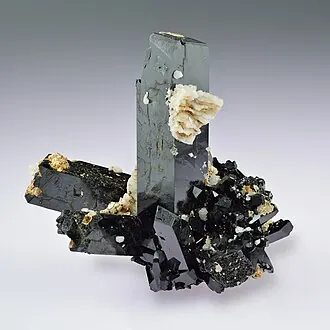
Aegirine — mineral specimen
Reference photograph: Wikimedia Commons · source. Specimens in the shop vary.

Judging quality

Slender terminated prisms with deep lengthwise striations and a bright vitreous lustre. Black tourmaline is trigonal with rounded triangular cross-sections.

Care

Brittle terminations. Handle by matrix.

History & lore

Named after Ægir, the Norse god of the sea, for the Norwegian type locality.

Cultural history, recorded as tradition rather than as medical or scientific claim.

Common questions about Aegirine

What is Aegirine?
Long, sharply striated black-green prisms, most famously from Mount Malosa in Malawi, where they grow with orange zircon and smoky quartz in some of the most photogenic combination specimens of recent decades.
How hard is Aegirine and what is it made of?
Aegirine is a Pyroxene-family mineral with the composition NaFeSi2O6. It crystallizes in the monoclinic system and rates 6-6.5 on the Mohs hardness scale. It occurs in black, black-green, bottle green.
Where does Aegirine come from?
Notable localities for Aegirine include Mount Malosa, Malawi, Kola Peninsula, Russia, Norway, Pakistan.
How do you tell good Aegirine from filler?
Slender terminated prisms with deep lengthwise striations and a bright vitreous lustre. Black tourmaline is trigonal with rounded triangular cross-sections.
How do you care for Aegirine?
Brittle terminations. Handle by matrix.

See it in person

Photographs only go so far

Both rooms are open six days a week, and there is always someone happy to pull pieces out of the case so you can compare them under the light.

Plan a visit
Share Aegirine