Judging quality
Look for glassy lustre, sharp cube edges and strong color zoning. Many fluorites fluoresce blue under UV — the phenomenon is named after the mineral. Cleaved octahedra are shaped by hand, not grown.
Halide
The most colorful mineral in the world, fluorite grows in perfect cubes and octahedra, often color-zoned in bands of green, purple and clear within a single crystal.
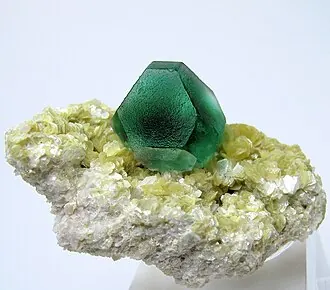
Look for glassy lustre, sharp cube edges and strong color zoning. Many fluorites fluoresce blue under UV — the phenomenon is named after the mineral. Cleaved octahedra are shaped by hand, not grown.
Soft, with perfect cleavage in four directions. Chips easily; keep out of sunlight, which fades some purple material.
Blue John fluorite from Castleton, Derbyshire has been carved into vases since the eighteenth century and is found nowhere else.
Cultural history, recorded as tradition rather than as medical or scientific claim.
See it in person
Both rooms are open six days a week, and there is always someone happy to pull pieces out of the case so you can compare them under the light.