Chalcedony

Dendritic Agate

Translucent chalcedony containing black fern-like dendrites of manganese oxide that look exactly like plants but are pure mineral growth along fractures.
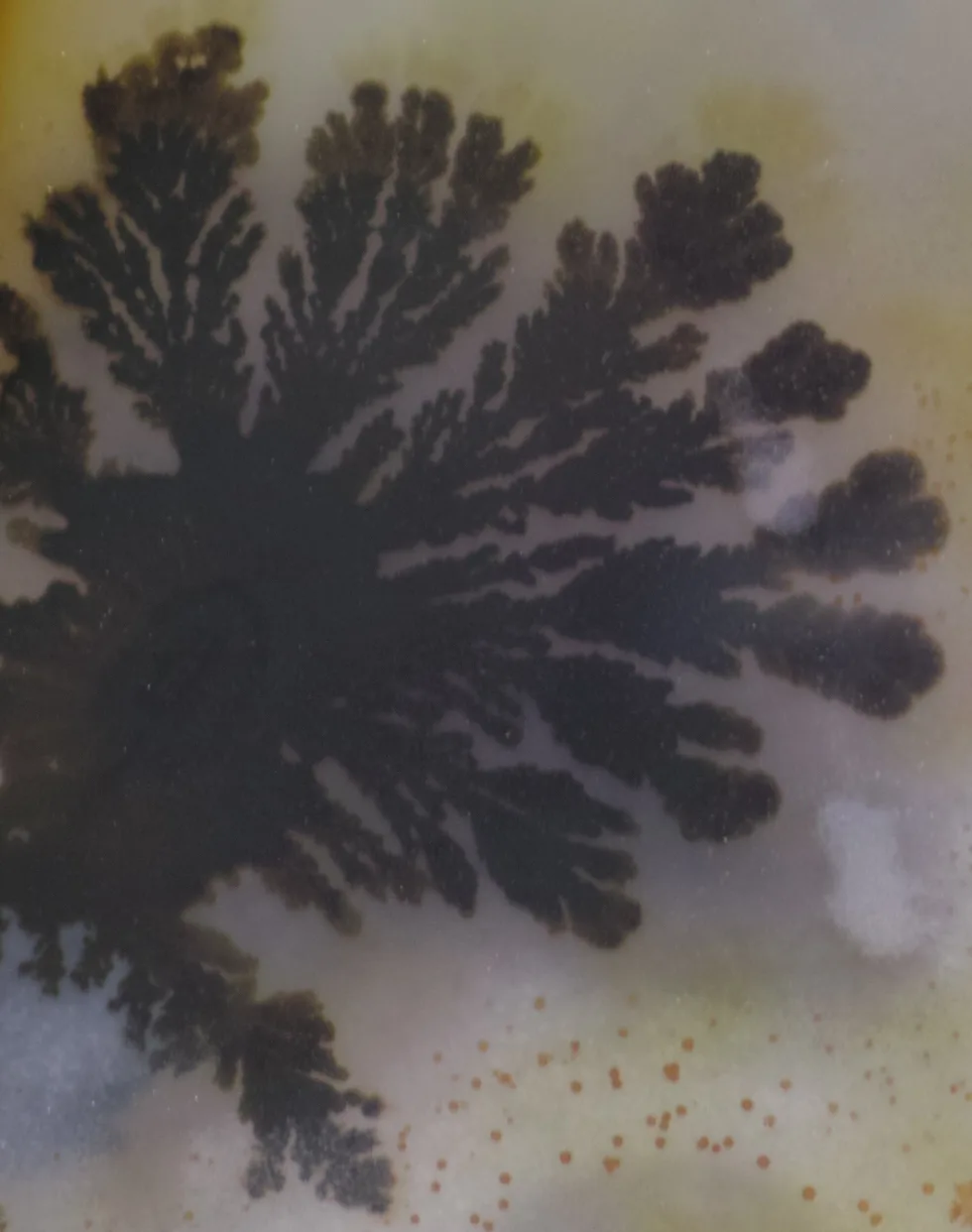
Dendritic Agate — mineral specimen
Reference photograph: 峠 武宏, CC BY-SA 3.0 · source. Specimens in the shop vary.

Judging quality

Dendrites are two-dimensional, spreading along a plane rather than through the volume. Genuine moss agate has three-dimensional inclusions; dendritic patterns are flat.

Care

Hard; no special handling.

History & lore

Montana agate from the Yellowstone River gravels is the classic American dendritic material, collected since the 1890s.

Cultural history, recorded as tradition rather than as medical or scientific claim.

Common questions about Dendritic Agate

What is Dendritic Agate?
Translucent chalcedony containing black fern-like dendrites of manganese oxide that look exactly like plants but are pure mineral growth along fractures.
How hard is Dendritic Agate and what is it made of?
Dendritic Agate is a Chalcedony-family mineral with the composition SiO2 with Mn/Fe oxides. It crystallizes in the trigonal system and rates 6.5-7 on the Mohs hardness scale. It occurs in white, colorless, black, brown.
Where does Dendritic Agate come from?
Notable localities for Dendritic Agate include India, Brazil, Kazakhstan, Montana, USA.
How do you tell good Dendritic Agate from filler?
Dendrites are two-dimensional, spreading along a plane rather than through the volume. Genuine moss agate has three-dimensional inclusions; dendritic patterns are flat.
How do you care for Dendritic Agate?
Hard; no special handling.

See it in person

Photographs only go so far

Both rooms are open six days a week, and there is always someone happy to pull pieces out of the case so you can compare them under the light.

Plan a visit
Share Dendritic Agate