Judging quality
Value lives in the picture: well-separated, finely branched dendrites in clear host material, ideally forming a recognisable scene. Muddy, crowded inclusions are common.
Chalcedony
Translucent chalcedony filled with dendritic mineral growths that look like moss, ferns or distant trees. Not banded, so technically not a true agate.
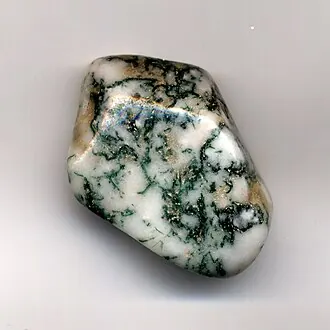
Value lives in the picture: well-separated, finely branched dendrites in clear host material, ideally forming a recognisable scene. Muddy, crowded inclusions are common.
Durable and easy — soap and water.
Nineteenth-century collectors called landscape-forming pieces 'scenic agates' and mounted them as miniature paintings.
Cultural history, recorded as tradition rather than as medical or scientific claim.
See it in person
Both rooms are open six days a week, and there is always someone happy to pull pieces out of the case so you can compare them under the light.