Halide

Halite

Rock salt, crystallising in perfect cubes — sometimes hopper-shaped with stepped hollow faces. Rare blue halite from German potash mines gets its color from lattice defects, not impurities.
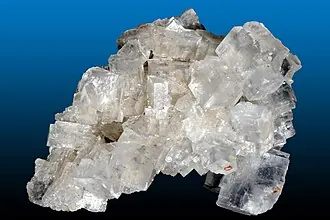
Halite — mineral specimen
Reference photograph: Wikimedia Commons · source. Specimens in the shop vary.

Judging quality

Cubic cleavage in three directions and, definitively, a salty taste. It dissolves in water instantly, which no imitation does.

Care

Water-soluble and hygroscopic. Keep sealed with desiccant in a humid climate; never wash.

History & lore

The Wieliczka salt mine near Kraków has been worked since the thirteenth century and contains chapels carved entirely from halite.

Cultural history, recorded as tradition rather than as medical or scientific claim.

Common questions about Halite

What is Halite?
Rock salt, crystallising in perfect cubes — sometimes hopper-shaped with stepped hollow faces. Rare blue halite from German potash mines gets its color from lattice defects, not impurities.
How hard is Halite and what is it made of?
Halite is a Halide-family mineral with the composition NaCl. It crystallizes in the cubic system and rates 2-2.5 on the Mohs hardness scale. It occurs in colorless, pink, blue, orange.
Where does Halite come from?
Notable localities for Halite include Searles Lake, California, USA, Wieliczka, Poland, Germany, Iran.
How do you tell good Halite from filler?
Cubic cleavage in three directions and, definitively, a salty taste. It dissolves in water instantly, which no imitation does.
How do you care for Halite?
Water-soluble and hygroscopic. Keep sealed with desiccant in a humid climate; never wash.

See it in person

Photographs only go so far

Both rooms are open six days a week, and there is always someone happy to pull pieces out of the case so you can compare them under the light.

Plan a visit
Share Halite