Concretion

Septarian Nodule

Mud concretions that dried and cracked internally, then had the cracks filled with golden calcite and brown aragonite — a fossil record of shrinkage roughly fifty million years old.
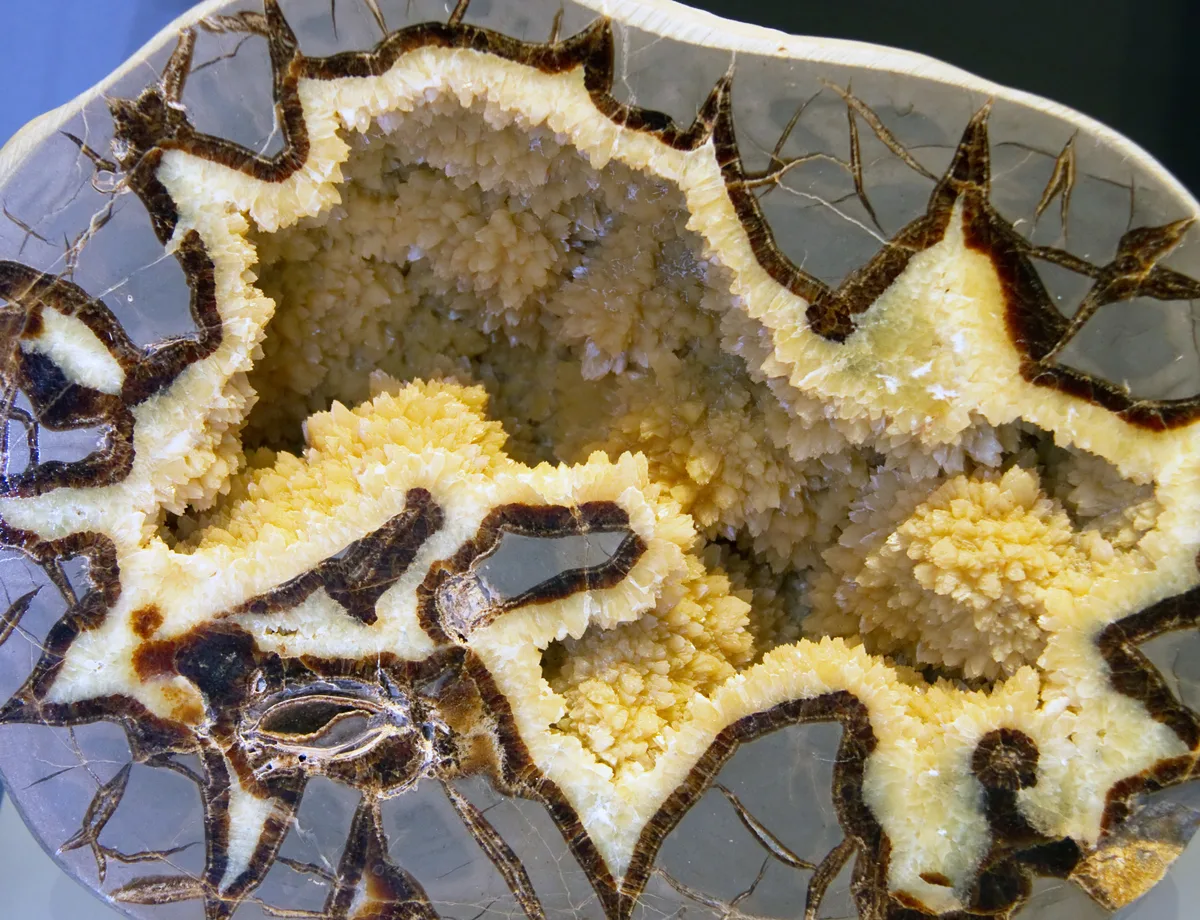
Septarian Nodule — mineral specimen
Reference photograph: Tony Hisgett, CC BY 2.0 · source. Specimens in the shop vary.

Judging quality

The best pieces have bold golden calcite veining in high contrast against grey-brown matrix and a mirror polish with no undercut soft spots.

Care

Mixed hardness means the polish can dull unevenly. Dust and wipe with a damp cloth.

History & lore

The name comes from Latin septum, partition, for the internal walls of crystal.

Cultural history, recorded as tradition rather than as medical or scientific claim.

Common questions about Septarian Nodule

What is Septarian Nodule?
Mud concretions that dried and cracked internally, then had the cracks filled with golden calcite and brown aragonite — a fossil record of shrinkage roughly fifty million years old.
How hard is Septarian Nodule and what is it made of?
Septarian Nodule is a Concretion-family mineral with the composition CaCO3 / BaSO4 / clay. It crystallizes in the mixed system and rates 3-4 on the Mohs hardness scale. It occurs in yellow, brown, grey.
Where does Septarian Nodule come from?
Notable localities for Septarian Nodule include Madagascar, USA (Utah), Morocco.
How do you tell good Septarian Nodule from filler?
The best pieces have bold golden calcite veining in high contrast against grey-brown matrix and a mirror polish with no undercut soft spots.
How do you care for Septarian Nodule?
Mixed hardness means the polish can dull unevenly. Dust and wipe with a damp cloth.

See it in person

Photographs only go so far

Both rooms are open six days a week, and there is always someone happy to pull pieces out of the case so you can compare them under the light.

Plan a visit
Share Septarian Nodule