Judging quality
A genuine rostrum has radial fibres visible on any broken end and a small conical socket at the wide end. Perfect uniform 'bullets' with no socket are usually reshaped fragments.
Fossil
The bullet-shaped internal skeleton of an extinct squid relative. Cut and polished, the calcite shows a radiating fibrous structure from a central apical line.
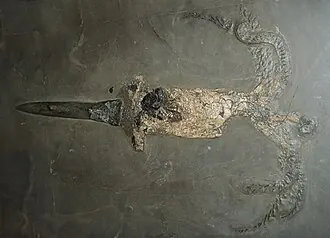
A genuine rostrum has radial fibres visible on any broken end and a small conical socket at the wide end. Perfect uniform 'bullets' with no socket are usually reshaped fragments.
Calcite: acid-sensitive and soft. Dry storage.
English country tradition called them thunderbolts or Devil's fingers, said to have fallen during storms.
Cultural history, recorded as tradition rather than as medical or scientific claim.
See it in person
Both rooms are open six days a week, and there is always someone happy to pull pieces out of the case so you can compare them under the light.