Chlorite

Seraphinite

A deep green clinochlore from one Siberian locality, shot through with silvery feather patterns that look like folded wings. Every piece comes from the Lake Baikal region; there is no second source.
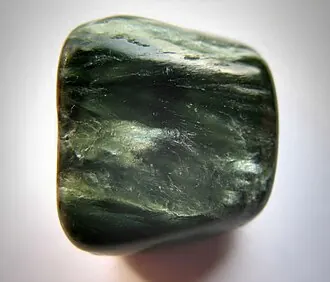
Seraphinite — mineral specimen
Reference photograph: Wikimedia Commons · source. Specimens in the shop vary.

Judging quality

The chatoyant silver feathering must be three-dimensional and shift as the stone turns. Flat printed green stone with static white marks is not seraphinite.

Care

Very soft. No water soaking, no ultrasonics, no abrasive cloths. Keep out of jewellery that takes knocks.

History & lore

Named for the seraphim by the Russian mineral trade in the nineteenth century, for the wing-like plumes.

Cultural history, recorded as tradition rather than as medical or scientific claim.

Common questions about Seraphinite

What is Seraphinite?
A deep green clinochlore from one Siberian locality, shot through with silvery feather patterns that look like folded wings. Every piece comes from the Lake Baikal region; there is no second source.
How hard is Seraphinite and what is it made of?
Seraphinite is a Chlorite-family mineral with the composition (Mg,Fe)6(Si,Al)4O10(OH)8. It crystallizes in the monoclinic system and rates 2-2.5 on the Mohs hardness scale. It occurs in bottle green, silver-green, silver.
Where does Seraphinite come from?
Notable localities for Seraphinite include Korshunovskoye, Lake Baikal, Siberia, Russia.
How do you tell good Seraphinite from filler?
The chatoyant silver feathering must be three-dimensional and shift as the stone turns. Flat printed green stone with static white marks is not seraphinite.
How do you care for Seraphinite?
Very soft. No water soaking, no ultrasonics, no abrasive cloths. Keep out of jewellery that takes knocks.

See it in person

Photographs only go so far

Both rooms are open six days a week, and there is always someone happy to pull pieces out of the case so you can compare them under the light.

Plan a visit
Share Seraphinite