Judging quality
The fibres compress and spring back slightly. Any stiff, chalky white ball is more likely mesolite or a weathered zeolite.
Zeolite-associated
Puffball sprays of hair-fine white fibres sitting in basalt cavities — often described as cotton balls, and genuinely soft to the touch, since the fibres flex under a finger.
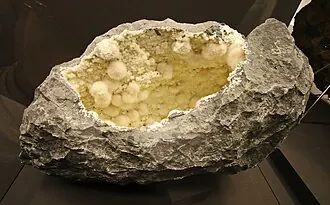
The fibres compress and spring back slightly. Any stiff, chalky white ball is more likely mesolite or a weathered zeolite.
Extremely delicate and impossible to clean once soiled. Keep in a closed case, never touch the sprays, never wash.
The Deccan Traps basalt quarries of Maharashtra have produced the world's finest zeolite specimens for over a century, largely as a by-product of road aggregate.
Cultural history, recorded as tradition rather than as medical or scientific claim.
See it in person
Both rooms are open six days a week, and there is always someone happy to pull pieces out of the case so you can compare them under the light.