Judging quality
Look for transparency and even blue; most rough is heat-treated to remove green tones, which is standard practice. Sharp prism faces and undamaged terminations matter most in specimens.
Beryl
Blue beryl, colored by iron, and the same mineral species as emerald and morganite. Crystals grow as long hexagonal prisms with flat terminations and can reach enormous size.
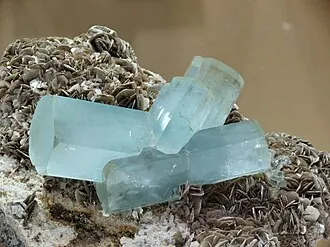
Look for transparency and even blue; most rough is heat-treated to remove green tones, which is standard practice. Sharp prism faces and undamaged terminations matter most in specimens.
Hard and durable but can chip on the edges. Warm soapy water is safe.
The Marta Rocha crystal found in Brazil in 1954 weighed over thirty kilos and remains one of the great gem finds of the century.
Cultural history, recorded as tradition rather than as medical or scientific claim.
See it in person
Both rooms are open six days a week, and there is always someone happy to pull pieces out of the case so you can compare them under the light.