Borate

Colemanite

Glassy colorless borate crystals that grow in blocky, brilliantly lustrous groups. Californian material from the Death Valley borate districts set the standard.
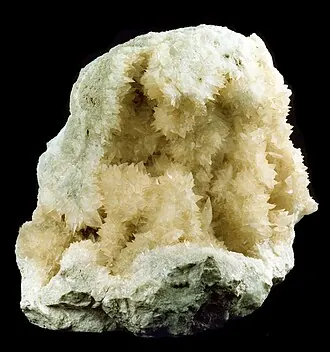
Colemanite — mineral specimen
Reference photograph: Bureau of Mines, Public domain · source. Specimens in the shop vary.

Judging quality

Brilliant vitreous faces with one perfect cleavage; it is harder than ulexite and not water-soluble. Many specimens fluoresce faintly.

Care

Cleaves readily. Handle by matrix and avoid ultrasonics.

History & lore

Named for William Coleman, whose Death Valley borax operation gave rise to the famous twenty-mule teams.

Cultural history, recorded as tradition rather than as medical or scientific claim.

Common questions about Colemanite

What is Colemanite?
Glassy colorless borate crystals that grow in blocky, brilliantly lustrous groups. Californian material from the Death Valley borate districts set the standard.
How hard is Colemanite and what is it made of?
Colemanite is a Borate-family mineral with the composition CaB3O4(OH)3·H2O. It crystallizes in the monoclinic system and rates 4-4.5 on the Mohs hardness scale. It occurs in colorless, white, cream.
Where does Colemanite come from?
Notable localities for Colemanite include Death Valley & Boron, California, USA, Turkey (Bigadiç).
How do you tell good Colemanite from filler?
Brilliant vitreous faces with one perfect cleavage; it is harder than ulexite and not water-soluble. Many specimens fluoresce faintly.
How do you care for Colemanite?
Cleaves readily. Handle by matrix and avoid ultrasonics.

See it in person

Photographs only go so far

Both rooms are open six days a week, and there is always someone happy to pull pieces out of the case so you can compare them under the light.

Plan a visit
Share Colemanite