Silicate

Danburite

Chisel-tipped prisms of glassy calcium boron silicate, most familiar from the Charcas mines of San Luis Potosí where crystals grow water-clear and doubly terminated.
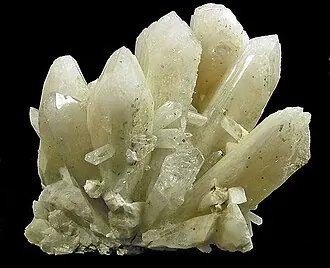
Danburite — mineral specimen
Reference photograph: Robert M. Lavinsky, CC BY-SA 3.0 · source. Specimens in the shop vary.

Judging quality

Danburite looks like topaz but has no easy cleavage and a distinctly wedge-shaped termination. Mexican crystals often show a faint pink core.

Care

Hard and stable; wash with water. Terminations chip if knocked.

History & lore

Named for Danbury, Connecticut, where it was first found in 1839 — the type locality is now built over.

Cultural history, recorded as tradition rather than as medical or scientific claim.

Common questions about Danburite

What is Danburite?
Chisel-tipped prisms of glassy calcium boron silicate, most familiar from the Charcas mines of San Luis Potosí where crystals grow water-clear and doubly terminated.
How hard is Danburite and what is it made of?
Danburite is a Silicate-family mineral with the composition CaB2Si2O8. It crystallizes in the orthorhombic system and rates 7-7.5 on the Mohs hardness scale. It occurs in colorless, pale yellow, blush.
Where does Danburite come from?
Notable localities for Danburite include Charcas, Mexico, Madagascar, Myanmar, Japan.
How do you tell good Danburite from filler?
Danburite looks like topaz but has no easy cleavage and a distinctly wedge-shaped termination. Mexican crystals often show a faint pink core.
How do you care for Danburite?
Hard and stable; wash with water. Terminations chip if knocked.

See it in person

Photographs only go so far

Both rooms are open six days a week, and there is always someone happy to pull pieces out of the case so you can compare them under the light.

Plan a visit
Share Danburite