Judging quality
Most blue topaz is irradiated colorless material, which is standard and stable. Imperial topaz is naturally colored, far rarer and priced accordingly. Look for clean terminations on specimens.
Silicate
A very hard silicate that grows in glassy prismatic crystals. Imperial topaz, the sherry-orange to pink material from Ouro Preto, is the aristocrat of the family.
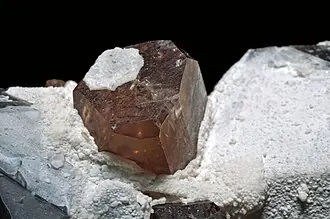
Most blue topaz is irradiated colorless material, which is standard and stable. Imperial topaz is naturally colored, far rarer and priced accordingly. Look for clean terminations on specimens.
Hard but with perfect basal cleavage; a sharp knock in the wrong plane will split it. Avoid ultrasonic cleaning.
Brazil's Ouro Preto district has been the sole significant source of imperial topaz since the eighteenth century.
Cultural history, recorded as tradition rather than as medical or scientific claim.
See it in person
Both rooms are open six days a week, and there is always someone happy to pull pieces out of the case so you can compare them under the light.