Sulfide

Marcasite

Chemically identical to pyrite but crystallising in a different system, marcasite is paler, more brittle and prone to breaking down over time.
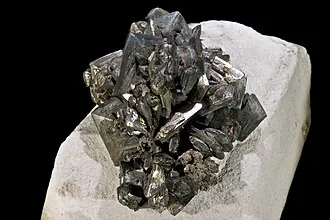
Marcasite — mineral specimen
Reference photograph: Didier Descouens, CC BY-SA 4.0 · source. Specimens in the shop vary.

Judging quality

Marcasite is lighter and more silvery than pyrite and often forms cockscomb or spearhead groups. Check for the powdery decay that indicates active oxidation.

Care

Unstable in humid air and can crumble. Store dry with a desiccant; the 'marcasite' in antique jewellery is almost always pyrite.

History & lore

Victorian jewellers used faceted pyrite chips as a mourning-appropriate alternative to diamonds.

Cultural history, recorded as tradition rather than as medical or scientific claim.

Common questions about Marcasite

What is Marcasite?
Chemically identical to pyrite but crystallising in a different system, marcasite is paler, more brittle and prone to breaking down over time.
How hard is Marcasite and what is it made of?
Marcasite is a Sulfide-family mineral with the composition FeS2. It crystallizes in the orthorhombic system and rates 6-6.5 on the Mohs hardness scale. It occurs in pale brass, silver.
Where does Marcasite come from?
Notable localities for Marcasite include USA (Illinois, Oklahoma), Czech Republic, France.
How do you tell good Marcasite from filler?
Marcasite is lighter and more silvery than pyrite and often forms cockscomb or spearhead groups. Check for the powdery decay that indicates active oxidation.
How do you care for Marcasite?
Unstable in humid air and can crumble. Store dry with a desiccant; the 'marcasite' in antique jewellery is almost always pyrite.

See it in person

Photographs only go so far

Both rooms are open six days a week, and there is always someone happy to pull pieces out of the case so you can compare them under the light.

Plan a visit
Share Marcasite