Judging quality
The prize is a crisp, straight boundary between saturated purple and clear gold, with both colors strong. Diffuse or pale zoning, and synthetic ametrine, are both widespread.
Quartz
A single quartz crystal zoned into amethyst purple and citrine gold, formed where differing temperatures acted on opposite ends of the same crystal. Commercially it comes essentially from one deposit in eastern Bolivia.
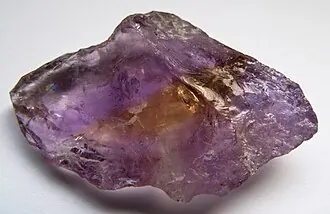
The prize is a crisp, straight boundary between saturated purple and clear gold, with both colors strong. Diffuse or pale zoning, and synthetic ametrine, are both widespread.
Keep out of prolonged sunlight to protect the amethyst zone.
The Anahi Mine entered European awareness in the seventeenth century as a dowry gift to a Spanish conquistador, then was lost for three hundred years.
Cultural history, recorded as tradition rather than as medical or scientific claim.
See it in person
Both rooms are open six days a week, and there is always someone happy to pull pieces out of the case so you can compare them under the light.