Judging quality
Look for lustrous, well-terminated crystals with the characteristic yellow-green tone; Pakistani epidote on quartz is the classic collector combination.
Silicate
Distinctly pistachio-green striated crystals with a resinous lustre, often forming radiating sprays on quartz or prehnite.
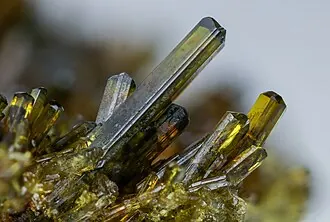
Look for lustrous, well-terminated crystals with the characteristic yellow-green tone; Pakistani epidote on quartz is the classic collector combination.
Reasonably hard but brittle along the length. Rinse gently.
Named from Greek epidosis, 'increase', for the way one side of its crystal base is longer than the other.
Cultural history, recorded as tradition rather than as medical or scientific claim.
See it in person
Both rooms are open six days a week, and there is always someone happy to pull pieces out of the case so you can compare them under the light.