Judging quality
Distinguished from quartz by higher refractive index and from white topaz by a lower one; a refractometer settles it instantly. Crystals show the same flat-terminated hexagonal habit as aquamarine.
Beryl
Colorless beryl — the pure end member with no coloring trace elements at all. It is the parent of every other beryl variety and makes an unusually crisp, clean faceted stone.
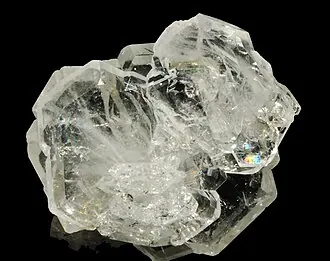
Distinguished from quartz by higher refractive index and from white topaz by a lower one; a refractometer settles it instantly. Crystals show the same flat-terminated hexagonal habit as aquamarine.
Durable and stable in light. Ordinary cleaning.
Named for Goshen, Massachusetts, where the type material was found; ground beryl lenses were used as spectacles in medieval Europe, and the German word Brille still carries the root.
Cultural history, recorded as tradition rather than as medical or scientific claim.
See it in person
Both rooms are open six days a week, and there is always someone happy to pull pieces out of the case so you can compare them under the light.