Judging quality
Look for even color, glassy prism faces and clean interiors — beryl of this color is often eye-clean, so visible inclusions cost real money. Irradiated material tends toward an over-saturated orange-gold.
Beryl
Golden beryl, colored by iron — the sunlit member of the family that also gives emerald, aquamarine and morganite. Ukrainian Volyn crystals are the classic: sharp hexagonal prisms in champagne to deep gold.
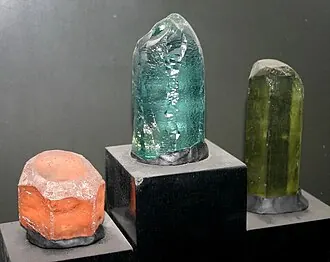
Look for even color, glassy prism faces and clean interiors — beryl of this color is often eye-clean, so visible inclusions cost real money. Irradiated material tends toward an over-saturated orange-gold.
Durable. Soapy water; avoid steam cleaning on included stones.
The name means 'gift of the sun', coined for the Namibian discoveries of the 1910s.
Cultural history, recorded as tradition rather than as medical or scientific claim.
See it in person
Both rooms are open six days a week, and there is always someone happy to pull pieces out of the case so you can compare them under the light.