Arsenate

Adamite

Bright yellow-green zinc arsenate crusts, best known from the Ojuela mine at Mapimí where it carpets brown limonite matrix in glowing druzy sprays.
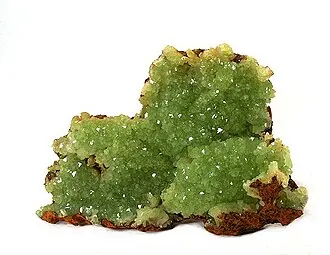
Adamite — mineral specimen
Reference photograph: Robert M. Lavinsky, CC BY-SA 3.0 · source. Specimens in the shop vary.

Judging quality

Most adamite fluoresces intense green under longwave UV, which is the quickest confirmation. Color comes from trace uranium and copper.

Care

Arsenate mineral: handle dry, wash hands, do not wash specimens. Keep from strong light to preserve fluorescence-linked color.

History & lore

Named for the French mineralogist Gilbert-Joseph Adam, who supplied the first described material in 1866.

Cultural history, recorded as tradition rather than as medical or scientific claim.

Common questions about Adamite

What is Adamite?
Bright yellow-green zinc arsenate crusts, best known from the Ojuela mine at Mapimí where it carpets brown limonite matrix in glowing druzy sprays.
How hard is Adamite and what is it made of?
Adamite is a Arsenate-family mineral with the composition Zn2(AsO4)(OH). It crystallizes in the orthorhombic system and rates 3.5 on the Mohs hardness scale. It occurs in yellow-green, lime, yellow.
Where does Adamite come from?
Notable localities for Adamite include Mapimí, Durango, Mexico, Greece (Lavrion), Namibia (Tsumeb).
How do you tell good Adamite from filler?
Most adamite fluoresces intense green under longwave UV, which is the quickest confirmation. Color comes from trace uranium and copper.
How do you care for Adamite?
Arsenate mineral: handle dry, wash hands, do not wash specimens. Keep from strong light to preserve fluorescence-linked color.

See it in person

Photographs only go so far

Both rooms are open six days a week, and there is always someone happy to pull pieces out of the case so you can compare them under the light.

Plan a visit
Share Adamite